David Starr Jordan was born on an apple orchard in upstate New York in 1851. As a boy he was fascinated by the stars and curious about the name and significance of the celestial bodies. When he was about eight, he got an atlas of astronomical charts and began comparing what he saw on the page to what he saw above his head. In five years he got his curiosity satisfied.
He then turned to the terrestrial. In between the chores his parents assigned him to do, and with the help of his big brother Rufus, he drew maps of his family's orchard, his walk to school, then copied charts of distant townships, states, countries, continents, all the way to every corner of the globe his hungry little fingers could crawl over.
Such eagerness worried his mother. One day she threw away piles of his son's creased, sweat stained maps and told him to find something “more relevant” to do with his time.
He obeyed and stopped making maps, but picked up the habit of picking wild flowers and plants he saw in his countryside surroundings to learn their names and locations in the biological map.
After graduating from Cornell University with both a Bachelor's degree in Science and a Master's in Botany in three years, he landed a job in Illinois teaching science at a small Christian university. But after attending a summer camp in Penikese Island, Massachusetts, organized by then famous naturalist Louis Agassiz to train young scholars for explorative collection of marine and botanical life, he decided to set his sights on the water. “The literature of Ichthyology (study of fishes) was inexact and incomplete,” he wrote, “with few comparative studies, so that the field seemed wide open, as indeed it was.”
As he jumped from teaching job to teaching job at schools all over the Midwest, he set himself the goal of discovering every freshwater fish in North America, while taking a job from the US Census Bureau
in 1880
to catalog the fish species that lived along the Pacific coast.
He then journeyed back to Bloomington, Indiana, where he had finally secured a permanent job as a professor of science at Indiana University. Six years later, when he was 34, the board of trustees asked him to become president of the institution. He accepted, making him the youngest university president in the entire country.
He now led a crew of burly, bespectacled taxonomists discovering fish faster than they could name them. They were preserving them in jars of ethanol and stacking them on shelves inside David’s secluded lab on the top floor of the science building. Thousands of mysterious creatures being piled higher and higher, awaiting their sacred naming ceremony.
Late one night in July of 1883, the lab caught fire. Jars exploded, fish vaporized, every last specimen was destroyed, and more: a secret document that David had been working for years, that mapped the connections of never-before-seen branches of tree of life, completely torched. “The flames of an hour had near undone his life work,” a reporter wrote on the local newspaper.
But David refused to be stalled by the catastrophe. He dusted up the ashes, and headed right back out to the nation’s bodies of water to retrieve what he had lost. He claimed to have learned only one lesson from the whole ordeal: “To publish at once,” he wrote.
Just two years later, another disaster struck. His wife, Susan, came down with a cough. Days later, she was dead. Killed, as their daughter Edith explains, by a bout of pneumonia the “rural town doctors were unable to cure.”
Again, David moved quickly. He held a simple but ceremonial funeral and then, as he had with the fish, headed right back out to the nation’s wilds, to retrieve what he had lost. Less than two years after Susan’s death, he had caught himself a new wife. A college sophomore named Jessie Knight, who's youthful, energetic, and enjoy traveling with him.
In time, a wealthy California couple heard about David—this cheerful, swashbuckling giant with hundreds of notches of scientific discovery on his belt. Their names were Leland and Jane Stanford, and one day in 1890, they traveled all the way to Bloomington to ask if he would become the first president of their little academic experiment in the farmlands of Palo Alto.
In 1891, he was sworn in as the founding president of Stanford University. He had just turned forty years old.
He immediately built a shiny new marine research facility on the tip of the Monterey Peninsula, the Hopkins Seaside Laboratory, modeled after Agassiz’s summer camp on Penikese Island.
Unhindered by financial constraints, at Stanford David commissioned fish-collecting expeditions to the places he had only been able to dream of, and map, as a boy. To Samoa he went, and to Russia, Cuba, Hawaii, Albania, Japan, Korea, Mexico, Switzerland, Greece, and beyond. Overall they collected and gave names to around one thousand new fish species, and many more piling higher and higher inside the lab at Stanford.
And then at 5:12 a.m. on April 18, 1906, the San Francisco earthquake struck. In just forty-seven seconds, decades of David's work got eliminated. Eels severed by shelves. Blowfish popped by shards of glass. For many of those specimens left intact, hundreds of them, nearly a thousand, their holy name tags had scattered all over the laboratory floor, his meticulously named fish had become an amorphous unknown again.
So what did David do?
To prevent the piles of fish from decaying, he had his crew water-hose them day and night before the ethanol he ordered arrived.
Then he sorted out the fish he could recognize, and sewed their name tag directly to their body. To its throat. To its tail. To its eyeball. So they would never get separated again.
David served Stanford as president until 1913 and then chancellor until his retirement in 1916. He died at his home on the Stanford campus after suffering a series of strokes over two years on September 19, 1931.
Thursday, April 30, 2020

Thursday, April 2, 2020
authenticity
In the fifties and early sixties, American TV shows idealized traditional families and suburban life so much people had an undercurrent fear that they might become a cookie cutter human being defined by the externals.
Today, with selfies, social media branding, and managing your profile on LinkedIn and Facebook, everyone seems to have become their own unabashed promoter. The new social mantra "Follow your passions. Do what you love" enjoins everyone to have some dream about their life and you are authentic to the extent that you doggedly pursue that vision as though it were your essence.
What does authenticity mean, and what does it mean to live authentically?
In Camus' novel "The Stranger", the protagonist commits a senseless murder but, in the end, is sentenced to death largely because he refuses to tell the officials and others what they want to hear, namely that he is sorry, which he isn't.
"In order to be, never try to seem," that seems to be one stern advise
Camus wants to tell us through the story.
Is there, however, more to authenticity than just "don't pretend"? Though Sartre tries, he can find no precise distinction between sincerity and authenticity as one might differentiate between tables and chairs, nor is it possible to generate an unambiguous criterion for deciding whether or not we are leading authentic lives. Perhaps like all ingredients of inner life, authenticity is something you just can't put on a scale and tell how much it weighs.
Etymologically speaking, both in Latin and in German, the idea of authenticity comes from the notion of making something your own. During the civil rights movement of the 1960s, many 19- and 20-year-olds, many of them first-generation college students whose parents had to dig deeply to send them to college, boarded buses southbound to help register voters and fight racism, knowing full well the maelstrom of violence they were driving into. That was authenticity on two counts. They were not taking marching orders from their parents or society in general, and they were acting on their own conviction.
"Be true to yourself", then, sounds like one great simple way to be authentic. The trick, and the trap to avoid, though, is how not to become a narcissist or self-righteous bigot following such easily turned self-serving moral guideline. After all, it could be argued that there were millions of Nazis who did just that, and hundreds of thousands of Americans who gave their last breath defending slavery.
"If authenticity is being true to ourselves ... then perhaps we can only achieve it integrally if we recognize that this sentiment connects us to a wider whole," says contemporary philosopher Charles Taylor in his book "The Ethics of Authenticity".
Relational creatures as we humans are, it could be that becoming our own person is only possible via strong bonds to something outside of ourselves. For Kierkegaard it is God, while Taylor submits this connection can take the form of binding yourself to a "political cause or tending to the earth."
Maybe we have taken this all wrong. Authenticity is not something we can work at, all we can do is to make efforts to avoid inauthenticity. So, for example, being vulnerable makes you closer to authenticity, while "faking it until you make it" makes you less so.
Or maybe authenticity is something we were born with, that got lost/buried under layers of layers of pseudo knowledge
as we got "educated" by culture, society and lots of our own "self-help" efforts. The task then is to shake off the chaff and shackles and get back to the original, "返璞歸真," as the Taoists would say.
Or follow a plan that is there from the start, to become who you truly are in God, as Kierkegaard would say.
* This writing is based on Chapter "Authenticity" of the book "The Existentialist's Survival Guide".
Monday, March 23, 2020
faith
I was out of town when the Philosophy Club group discussed the chapter "Faith" from the book "The Existentialist's Survival Guide" a few months ago. Now I've re-read it, my take is as follows:
The chapter started with the author--a non-practicing Catholic--recalling one accidental visit to a church one late afternoon when his original intent was to a bar, and could not work up a single candle at the chapel to light up for his long deceased father. As he left the church, feeling silly with such non-serendipitous event, a question nevertheless popped up in his head: Do we lose our faith or we push it away?
It's easy for a modern man to revolt against a faith whose truths are based on the "indisputable facts" of virgin birth and bodily resurrection. The argument that "God is beyond human understanding" sounds hollow and apologetic. Religion as a category could well be written off as an antiquated invention by humans for humans, their needs for assurance and protection at basic, and meaning and purpose at higher up psycho-emotional-spiritual levels.
For existentialists such as Camus, the conflict between our need for meaning and a meaningless world is the absurd. His prescription is that we accept the futility of our innermost desires and remain faithful to that recognition of the absurd.
Kierkegaard disagrees. In his book "Fear and Trembling" he writes:
"If a human being did not have an eternal consciousness, if underlying everything there were only a wild, fermenting power that writhing in dark passions produced everything, be it significant or insignificant, if a vast, never appeased emptiness hid beneath everything, what would life be then but despair? ... If a generation passed through the world as a ship through the sea, as wind through the desert, an unthinking and unproductive performance, if an eternal oblivion, perpetually hungry, lurked for its prey and there were no power strong enough to wrench that away from it--how empty and devoid of consolation life would be!"
"But precisely for that reason it is not so," Kierkegaard adds. That is, there is a God who watches over us and therefore life is good.
For Kierkegaard, the need for God does not reveal a lack. Just because our belief in God stems from a need for God, it doesn't follow that God does not exist. Or, as C. S. Lewis puts it: “If I find in myself a desire which no experience in this world can satisfy, the most probable explanation is that I was made for another world.”
Faith then, according to Kierkegaard, is:
A private affair between the individual and God, whose edict may create a "teleological suspension of the ethical," such as the story of Abraham binding his son Isaac on the altar shows.
An offense to the understanding. Jesus was not a sage with a message about teaching us to love one another, but a rebel whose words and acts offended the religious orders of the day.
The right framework for true self-knowledge. True-self is a particular, always in flux, always in becoming. Without God in the picture, it can easily lose hold of itself.
Not standard answers or sure-handed practices. Where there is certainty, there is no risk, and where there is no risk, there is no faith.
In the end, faith is trust. When reality slams the door on our fingers, we either wince and try to sustain trust in God, or we let go of him, as though God were a friend who betrayed us, when in truth it is we who push him away.
Friday, March 20, 2020
love
The Philosophy Club meetup group I've been attending since last year has focused their discussions on topics from the book "The Existentialist's Survival Guide" by Gordon Marino in the past few months. Due to the on-going pandemic, the meetup was canceled this week but we were encouraged to continue sharing our thoughts in alternative ways possible. So I wrote and shared with the group my take on the chapter titled "Love":
The main idea he then spent the latter third of the chapter, using Dostoyevsky's “Underground Man” story to explain, is that one has to deem oneself lovable before they can accept others' love and be capable of loving others as well.
Two issues on making thyself lovable: how to get rid of those self loathing feelings (guilt, shame, unworthiness, inadequacy, etc.), and how to avoid becoming a narcissist on the way to achieving self-love?
The answer to the first can be theological: a third party (God, religion) that can absolve the guilt/shame/unworthiness complex one has; or rational: by realizing all humans are equal, comparison is unnecessary, none is superior nor inferior to any other, therefore self loathing is unnecessary .
As to how not to become a narcissist while trying to love thyself, the book doesn't give a direct answer, but seems to indicate a non-human reference, an out-of-this-world role model is needed, so one can turn their egotistic eyes away from other human beings who they treat as mirrors of their own reflections anyway, and stop the endless struggle to establish themselves as a subject among others trying to do the same who are as flawed as they are in the first place.
And how can/does one love another person? Again a theological answer coming from Kierkegaard, is through the “command” of God, that asks His believers to "presuppose there is love in others" and do “love works” to uncover it; while a secular, existentialistic, but also Kierkegaardian answer, in my opinion, is treat it as a mystical goal that's unachievable but needs to be pursued anyway, all the way, by faith.
Tuesday, November 19, 2019
kyrgyzstan -- kids, students, and businessmen
Kyrgyzstan is a young country. Statistics says 34.4% of its population are under the age of 15 and 6.2% are over 65; my eyes told me whenever I went outdoor or going downtown I saw young workers or school children bustling/roaming on the streets, or toddlers on strollers by their young adult parents.
And kids are not about being shy or bashful, but bright and sprightly here. Say hi to a roomful of kindergarten kids and they all turn and vigorously greet you back. At one of the schools we visited, a 1st-grader-ish boy came up to us introducing himself as a boxer (the school did offer boxing lessons), and asked if we knew of Mike Tyson?... Bruce Lee?... Muhammad Ali?... Jean-Claude Van Damme...

The young, smart, fluent English speaking female principal of the vocational college we visited was actually a graduate from the first Christian school the foundation set up some 18 years ago, who came back to work at the college a couple years ago when it started and grew her way up to the principal position. Talking about sowing and harvesting, fruits of education.
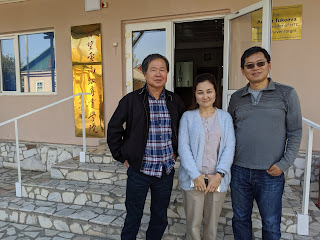
One expressed intent of my trip here was to meet and talk with the university's IT department staff and students, to get a feel and explore the possibility of bringing online development project opportunities to the motivated and talented.
My encounter with the IT students started off at a casual off-campus lunch with four of them (who all later became my group discussion members at the TWTS leadership training course): Abai, the typical, smart, computer wizard kid, Azamat, the pensive one, Iskak, the young and restless, and Aisulu, a bubbly girl who looked every inch like my niece-in-law in Taiwan. All seemed curiously excited about the possibilities I mentioned.
I then met with the IT department staff at school: Polina, the charming department head, Andrei, head of IT services for both the university and the vocational college, and Kochkorov, head of career development. All welcomed the ideas I proposed, as educational and potentially monetarily rewarding opportunities for the students. As a matter of fact, Andrei, who also taught web programming at the schools and had done some online projects himself, had thought about assembling a "programming club"--as many commercial IT companies in Bishkek have been doing for their junior programmers to practice development skills--to take on online projects for some of his students too.

So he informed and gathered a group of around 15 students he pre-selected to meet with me at school, where I introduced myself and my ideas and invited them to share their online development experiences--if any--with me and others. Out of a few who spoke, one 14-year-old said he had done some online project since age 12! Wow, I knew that's what I would find here (like anywhere else in the world)!

International Micro-Enterprise Development (IMED) is a micro-financing program that gives start-up loans to worthy small businesses that the foundation has started doing about a year ago. I got to see and meet those businesses and people who had received loans last year as the Special Project Manager from the foundation took me along for the program's follow-up visits.
Out of those we met--the tin metal maker, the wedding photographer, the carpenter, the plumber, the car repairman, and the beef jerky maker--three struck me with their unusual backgrounds and life stories:
S. was a Uzbek living in southwestern Kyrgyzstan, the most conservative and Islamic part of the country. When he and his brother's conversion to Christianity was known by their neighbors, an angry mob took them to a public ground and demanded that they recant and revert to their Islamic faith. When they refused the Imam turned his back and signaled the mob to stone them to death, but the police cars arrived in time to take them to safety. They and their families had since left their hometown and moved north here to start a new life where S. runs his carpentry business while pastoring and hosting weekly Bible studies for his relatives and other fellow Uzbek Christians here.
V. had an abusive Korean father (whose father was one of those displaced by Stalin from Russian Far East to Kazakhstan in the late 1930's) and an Armenian mother. At age 17 he was in such depression he almost killed his father or himself if not for his new found Christian faith. He graduated from the foundation's university and is now managing John (the Canadian)'s farm, studying for Master's degree on international project management, and starting a beef jerky manufacturing business with his friend/partner A.
A. is a German Kyrgyz of Mennonite descent who nowadays goes to Calvary Church in Bishkek. He had gone to study and got a business degree in Lithuania but decided to come back to fight for orphans' welfare in his home country. He works for World Without Orphans on legal matters while running the sales and marketing side of the beef jerky business he started with V. He is happily married with a lovely wife and 5 daughters, 4 of them orphans they adopted.
And kids are not about being shy or bashful, but bright and sprightly here. Say hi to a roomful of kindergarten kids and they all turn and vigorously greet you back. At one of the schools we visited, a 1st-grader-ish boy came up to us introducing himself as a boxer (the school did offer boxing lessons), and asked if we knew of Mike Tyson?... Bruce Lee?... Muhammad Ali?... Jean-Claude Van Damme...

The young, smart, fluent English speaking female principal of the vocational college we visited was actually a graduate from the first Christian school the foundation set up some 18 years ago, who came back to work at the college a couple years ago when it started and grew her way up to the principal position. Talking about sowing and harvesting, fruits of education.

One expressed intent of my trip here was to meet and talk with the university's IT department staff and students, to get a feel and explore the possibility of bringing online development project opportunities to the motivated and talented.
My encounter with the IT students started off at a casual off-campus lunch with four of them (who all later became my group discussion members at the TWTS leadership training course): Abai, the typical, smart, computer wizard kid, Azamat, the pensive one, Iskak, the young and restless, and Aisulu, a bubbly girl who looked every inch like my niece-in-law in Taiwan. All seemed curiously excited about the possibilities I mentioned.
I then met with the IT department staff at school: Polina, the charming department head, Andrei, head of IT services for both the university and the vocational college, and Kochkorov, head of career development. All welcomed the ideas I proposed, as educational and potentially monetarily rewarding opportunities for the students. As a matter of fact, Andrei, who also taught web programming at the schools and had done some online projects himself, had thought about assembling a "programming club"--as many commercial IT companies in Bishkek have been doing for their junior programmers to practice development skills--to take on online projects for some of his students too.

So he informed and gathered a group of around 15 students he pre-selected to meet with me at school, where I introduced myself and my ideas and invited them to share their online development experiences--if any--with me and others. Out of a few who spoke, one 14-year-old said he had done some online project since age 12! Wow, I knew that's what I would find here (like anywhere else in the world)!

International Micro-Enterprise Development (IMED) is a micro-financing program that gives start-up loans to worthy small businesses that the foundation has started doing about a year ago. I got to see and meet those businesses and people who had received loans last year as the Special Project Manager from the foundation took me along for the program's follow-up visits.
Out of those we met--the tin metal maker, the wedding photographer, the carpenter, the plumber, the car repairman, and the beef jerky maker--three struck me with their unusual backgrounds and life stories:
S. was a Uzbek living in southwestern Kyrgyzstan, the most conservative and Islamic part of the country. When he and his brother's conversion to Christianity was known by their neighbors, an angry mob took them to a public ground and demanded that they recant and revert to their Islamic faith. When they refused the Imam turned his back and signaled the mob to stone them to death, but the police cars arrived in time to take them to safety. They and their families had since left their hometown and moved north here to start a new life where S. runs his carpentry business while pastoring and hosting weekly Bible studies for his relatives and other fellow Uzbek Christians here.
V. had an abusive Korean father (whose father was one of those displaced by Stalin from Russian Far East to Kazakhstan in the late 1930's) and an Armenian mother. At age 17 he was in such depression he almost killed his father or himself if not for his new found Christian faith. He graduated from the foundation's university and is now managing John (the Canadian)'s farm, studying for Master's degree on international project management, and starting a beef jerky manufacturing business with his friend/partner A.
A. is a German Kyrgyz of Mennonite descent who nowadays goes to Calvary Church in Bishkek. He had gone to study and got a business degree in Lithuania but decided to come back to fight for orphans' welfare in his home country. He works for World Without Orphans on legal matters while running the sales and marketing side of the beef jerky business he started with V. He is happily married with a lovely wife and 5 daughters, 4 of them orphans they adopted.
Friday, November 15, 2019
kyrgyzstan -- missions and missionaries
In 1992, 64-year-old Captain Yang (楊嘉善), a former merchant marine captain, decided to retire and serve God in full time ministry. He turned over his shipping business to his employees and dedicated the rest of his life to mission work.
From 1995 - 2000, he and his wife ministered among the Dungan Muslim people in Kazakhstan. In spring 2000 they were moved to open Christian schools and orphanages in Kyrgyzstan. Miraculously, Kyrgyzstan's departments of Religion, Justice and Education granted Elder Yang the nation's first Christian school license. He soon set up a Christian charitable foundation and opened its first Christian School of Blessing in September 2000 with 120 students from 1st-4th grades.
As of today, the foundation operates/supports five schools (mostly 1st-11th grades) and two orphanages that serve over 1200 children, and a university and a vocational college that offer business, law, linguistic, pedagogy, international relations, and information technology studies to over 400 students, as well as a gym and a playground with youth and pre-school programs in northern Kyrgyzstan.


Christian funded or not, proselytization and open adulation of Christianity is not allowed in Kyrgyzstan. An off-campus student fellowship/counseling program is thus set up and conducted by Jean, a lady pastor from Taiwan who has been residing and hosting weekly meetups, organizing summer/winter camps, providing life coaching, etc., to young adults here for well over a year.

Another off-campus, annual event organized by the foundation is a Christian value based leadership development program (called "The Way To Success") that invites seasoned business people as speakers and mentors to teach and facilitate the training for those who choose to participate.
Spencer and Diane are such speakers. They are a couple originally from Kansas and veterans of corporate world before leaving it for mission fields. They--along with their three young children--had been living among the Uyghurs in Chinese Xinjiang region for 5 years until the Chinese government decided not to renew their visa and moved here a year and a half ago.

Paul is another layman-turned-missionary that I met through the TWTS program (where I cameoed as a mentor). He was originally from Wisconsin and a gifted addiction/crisis counselor by profession, before he met Captain Yang's ministry in the States and decided to become a full time missionary himself. Before coming to Kyrgyzstan six months ago, he and his Chinese wife Angela had spent a couple years in southwestern China (雲南) evangelizing tea growers there.
From a rigid Catholic background (he is the 7th child of two church going Catholic parents), he had "converted" to a pro-active, but very kind and thoughtful evangelical in this land of non-Christian-believers. He told me two contrasting episodes that recently happened to him: In one someone knocked on his apartment door and advised he keep a low profile in his evangelical activism here; In another he was invited to a rural village by a Kyrgyz woman whose recently deceased husband was a non-practicing Scottish Christian to speak in his funeral and he took the opportunity to pronounce his faith and the gospel message at the end of his speech to hundreds of Muslims in the audience, knowing full well what dangers such pronunciation might bring him.

I met Sandra at one of those student fellowship functions Jean organized. She told me she was originally from Ohio but later moved to Arizona and then sold her property there to travel the world on missions. She has been living in a house she bought 5 years ago in the former Mennonite village and working on rescuing and educating women who are victims of bride kidnapping that she said is still quite common practice here.
John is a Canadian who came to Kyrgyzstan 4 years ago and with his churches' backing set up a farm for adult orphans who "graduated" from orphanages without employable skills and/or places to live. He had since extended his farm to include guest houses for back-packers/eco-vacationers and sell handicrafts made by orphanage children to help achieve self-sustenance for the operation.

Last but not least, Butch, a retired chief executive of a big construction company in Illinois, has been the major benefactor and brain trust for the foundation for the past 15 years or so. He happened to be here on one of his frequent visits from the States and staying in the same complex as I so we hit off chatty conversations almost daily at breakfast in the homey kitchen. He struck me as an even-keeled Mid-Westerner and straight-talking Texan (indeed he just bought a ranch in central Texas and moved down there a couple months ago) combined, a rock solid guy befitting his position as chairman of the foundation that is particularly needed since Captain Yang, a very dear old friend of his since the founding of the foundation, had passed away more than two and a half years ago.

From 1995 - 2000, he and his wife ministered among the Dungan Muslim people in Kazakhstan. In spring 2000 they were moved to open Christian schools and orphanages in Kyrgyzstan. Miraculously, Kyrgyzstan's departments of Religion, Justice and Education granted Elder Yang the nation's first Christian school license. He soon set up a Christian charitable foundation and opened its first Christian School of Blessing in September 2000 with 120 students from 1st-4th grades.
As of today, the foundation operates/supports five schools (mostly 1st-11th grades) and two orphanages that serve over 1200 children, and a university and a vocational college that offer business, law, linguistic, pedagogy, international relations, and information technology studies to over 400 students, as well as a gym and a playground with youth and pre-school programs in northern Kyrgyzstan.
Spencer and Diane are such speakers. They are a couple originally from Kansas and veterans of corporate world before leaving it for mission fields. They--along with their three young children--had been living among the Uyghurs in Chinese Xinjiang region for 5 years until the Chinese government decided not to renew their visa and moved here a year and a half ago.
Paul is another layman-turned-missionary that I met through the TWTS program (where I cameoed as a mentor). He was originally from Wisconsin and a gifted addiction/crisis counselor by profession, before he met Captain Yang's ministry in the States and decided to become a full time missionary himself. Before coming to Kyrgyzstan six months ago, he and his Chinese wife Angela had spent a couple years in southwestern China (雲南) evangelizing tea growers there.
From a rigid Catholic background (he is the 7th child of two church going Catholic parents), he had "converted" to a pro-active, but very kind and thoughtful evangelical in this land of non-Christian-believers. He told me two contrasting episodes that recently happened to him: In one someone knocked on his apartment door and advised he keep a low profile in his evangelical activism here; In another he was invited to a rural village by a Kyrgyz woman whose recently deceased husband was a non-practicing Scottish Christian to speak in his funeral and he took the opportunity to pronounce his faith and the gospel message at the end of his speech to hundreds of Muslims in the audience, knowing full well what dangers such pronunciation might bring him.
I met Sandra at one of those student fellowship functions Jean organized. She told me she was originally from Ohio but later moved to Arizona and then sold her property there to travel the world on missions. She has been living in a house she bought 5 years ago in the former Mennonite village and working on rescuing and educating women who are victims of bride kidnapping that she said is still quite common practice here.
John is a Canadian who came to Kyrgyzstan 4 years ago and with his churches' backing set up a farm for adult orphans who "graduated" from orphanages without employable skills and/or places to live. He had since extended his farm to include guest houses for back-packers/eco-vacationers and sell handicrafts made by orphanage children to help achieve self-sustenance for the operation.
Tuesday, November 12, 2019
kyrgyzstan
For the past couple years we've been sponsoring an international university in Kyrgyzstan through a Christian foundation. I decided to pay an explorative visit to the country and the university while in Taipei.
A straight line flight from Taipei to Kyrgyzstan (3000 miles) would include an overnight stop-over in China that required Chinese visa which I didn't have, so I opted for an alternative route that took me off Taipei in early morning, stopped by Seoul for a couple hours, then a 7-hour beeline to Almaty, Kazakhstan, then a short hour flight to Bishkek, the capital city of Kyrgyzstan, before a driver and two students from the university picked me up at the airport and took me for a one-and-a-half hour drive to the town of my destination, Tokmok, while the night was still young.


To most people--me included--Kyrgyzstan is probably just one of those hard-to-spell "-stan" countries in the middle of nowhere Euro-Asia landmass. Indeed it is first of those "-stan" countries sprawling west of China (Kazakhstan to its north, Uzbekistan to the west and southwest, Tajikistan to the southwest), occupying a key section of the ancient international highway called Silk Road, carrying a mixed-bag of cultural and historical heritage spanning millennia, as ancient civilizations ebbed and flew, East and West met and left, at the heart of the Eurasian continent.
Take two ancient ruins I visited for examples: Suyab (碎葉) was once the principal capital of Western Turkic Khaganate (西突厥汗國) who got defeated by Emperor Taizong of Tang Dynasty (唐太宗), and the rumored birthplace of the famous Chinese poet 李白; Burana Tower was one of the oldest architectural construction (a minaret) in Central Asia, situated in the old capital of yet another Khaganate established by people of Iranian origin.


After some unsuccessful rebellions against Qing Dynasty by Chinese Muslims living in northwest China (陝甘回亂) in late 19th century, many of them chose to emigrate to Kyrgyzstan and other parts of Central Asia, whose descendants are now called Dungan ( 東干,東甘 ,甘肅東部 ) people, with whom you can carry on simple conversations in modern Chinese without much trouble.
Around the same time, a group of German speaking Mennonite Christians migrated from Europe to the northeast of Kyrgyzstan to escape religious persecution from the Catholic and other Reformed churches.
And tens of thousands of Korean families living in Russian Far East were force-moved by Stalin to this part of the world for fear of them being used as Japanese spies pre-World War II era.
Economically speaking, Kyrgyzstan is a poor country. It has few natural resources other than some minerals and water from the high mountains. Whatever little manufacturing industry it had collapsed after the Soviet Union breakup, and agriculture remains a major contributor to the country's GDP. Indeed I had tasted great delicious beet soup and potato mash, devoured biggest shish-kabobs ever, and crossed path with horse and cow herds on country roads.


I spent my 9-day stay at the Christian foundation's office-residential building rather than a hotel. It was a small two-story complex with nice meeting hall and homey kitchen, among other things, and a staff of capable and devoted Kyrgyz Christians who have done many great charitable works in a Muslim country for the past 18 years. I gave thanks to each of them and shared my spiritual journey with them in their daily morning devotion on the day I left.

A straight line flight from Taipei to Kyrgyzstan (3000 miles) would include an overnight stop-over in China that required Chinese visa which I didn't have, so I opted for an alternative route that took me off Taipei in early morning, stopped by Seoul for a couple hours, then a 7-hour beeline to Almaty, Kazakhstan, then a short hour flight to Bishkek, the capital city of Kyrgyzstan, before a driver and two students from the university picked me up at the airport and took me for a one-and-a-half hour drive to the town of my destination, Tokmok, while the night was still young.


Take two ancient ruins I visited for examples: Suyab (碎葉) was once the principal capital of Western Turkic Khaganate (西突厥汗國) who got defeated by Emperor Taizong of Tang Dynasty (唐太宗), and the rumored birthplace of the famous Chinese poet 李白; Burana Tower was one of the oldest architectural construction (a minaret) in Central Asia, situated in the old capital of yet another Khaganate established by people of Iranian origin.


People here still call Chinese "Khitan" (契丹) because that Chinese ethnic group came and established the Western Liao Dynasty (西遼王朝) and ruled them for 100 years during the 12-13th century.After some unsuccessful rebellions against Qing Dynasty by Chinese Muslims living in northwest China (陝甘回亂) in late 19th century, many of them chose to emigrate to Kyrgyzstan and other parts of Central Asia, whose descendants are now called Dungan ( 東干,東甘 ,甘肅東部 ) people, with whom you can carry on simple conversations in modern Chinese without much trouble.
Around the same time, a group of German speaking Mennonite Christians migrated from Europe to the northeast of Kyrgyzstan to escape religious persecution from the Catholic and other Reformed churches.
And tens of thousands of Korean families living in Russian Far East were force-moved by Stalin to this part of the world for fear of them being used as Japanese spies pre-World War II era.
Economically speaking, Kyrgyzstan is a poor country. It has few natural resources other than some minerals and water from the high mountains. Whatever little manufacturing industry it had collapsed after the Soviet Union breakup, and agriculture remains a major contributor to the country's GDP. Indeed I had tasted great delicious beet soup and potato mash, devoured biggest shish-kabobs ever, and crossed path with horse and cow herds on country roads.


Crossing path with horses:
https://youtu.be/ENbEoYjrFcc
For more photos and trip details:
Subscribe to:
Posts (Atom)