Saturday, March 5, 2011

g. k. chesterton

G. K. Chesterton (1874-1936) is an influential and prolific Christian writer of early 20th Century England. He's close to intellectuals and artists of his days such as George Bernard Shaw and Oscar Wilde and Bertrand Russell and an ardent Christian faith defender. One classic book of his that affects many Christian thinkers to come--one of them none other than C. S. Lewis, another great prolific Christian writer of latter half 20th Century--describes how he came from a pagan and agnostic youth to developing a personal, positive philosophy that turned out to be orthodox Christianity, hence the title "Orthodoxy."

I bought the book almost 6 months ago and never really had time to read it until recently. It is not a page-turner I'll say. It's brain twisting and highly intellectual, if the not-so-plain writing style hasn't mixed you up already. Yet you sense the deep thoughts and sharp wits and great humor right beneath, that he's trying to explain things serious and legitimate in a fun and paradoxical way. I began to enjoy it half way through the book, and going back sometimes to earlier chapters for second reading gave me more pleasure and better understanding than the first time around.

In Chapter Two, titled "The Maniac," for example, he argues the definition of what is sane and what is insane like this: 

There is a notion that imagination, especially mystic imagination, is dangerous to man's mental balance... but imagination does not breed insanity, exactly what does breed insanity is reason. Poets do not go mad; but chess-players do... Poetry is sane because it floats easily in an infinite sea; reason seeks to cross the infinite sea, and so make it finite. The result is mental exhaustion... The poet only asks to get his head into the heavens. It is the logician who seeks to get the heavens into his head. And it is his head that splits.

And "the madman's explanation of a thing is always complete and often in a purely rational sense satisfactory... that his mind moves in a perfect but narrow circle. A small circle is quite as infinite as a large circle; but, though it is quite as infinite, it is not so large... There is such a thing as a narrow universality; there is such a thing as a small and cramped eternity; you may see it in many modern religions."

Then he explains why materialist philosophy is so limiting even though it claims to be liberating from God/spiritual dominant thinking:

The Christian is quite free to believe that there is a considerable amount of settled order and inevitable development in the universe. But the materialist is not allowed to admit into his spotless machine the slightest speck of spiritualism or miracle... The Christian admits that the universe is manifold and even miscellaneous, just as the sane man knows that he is complex. The sane man knows that he has a touch of the beast, a touch of the devil, a touch of the saint, a touch of the citizen... even a touch of the madman. But the materialist's world is quite simple and solid, just as the madman is quite sure he is sane.

On egotism: It is possible to meet the skeptic who believes that everything began in himself... those seekers after the Superman who are always looking for him in the looking-glass, those writers who talk about impressing their personalities instead of creating life for the world, all these people have really only an inch between them and this awful emptiness.

In conclusion: "This chapter is purely practical and is concerned with what actually is the chief mark and element of insanity; we may say in summary that it is reason used without root, reason in the void. The man who begins to think without the proper first principles goes mad; he begins to think at the wrong end." What then keeps men sane? "Mysticism keeps men sane... The ordinary man has always been sane because the ordinary man has always been a mystic... He has always had one foot in earth and the other in fairyland. He has always left himself free to doubt his gods; but (unlike the agnostic of today) free also to believe in them... The whole secret of mysticism is this: that man can understand everything by the help of what he does not understand. The morbid logician seeks to make everything lucid, and succeeds in making everything mysterious. The mystic allows one thing to be mysterious, and everything else becomes lucid. The determinist makes the theory of causation quite clear, and then finds that he cannot say "if you please" to the housemaid. The Christian permits free will to remain a sacred mystery; but because of this his relations with the housemaid become of a sparkling and crystal clearness."

He then uses some symbolism and analogy to explain the difference between Buddhism and Christianity: Buddhism is centripetal (向心), but Christianity is centrifugal (離心): it breaks out. For the circle is perfect and infinite in its nature; but it is fixed forever in its size; it can never be larger or smaller. But the cross, though it has at its heart a collision and a contradiction, can extend its four arms forever without altering its shape. Because it has a paradox in its center it can grow without changing. The circle returns upon itself and is bound. The cross opens its arms to the four winds; it is a signpost for free travelers.

"The cross opens its arms to the four winds; it is a signpost for free travelers." I really like that!


* Chesterton was a large man, standing 6 feet 4 inches and weighing around 290 lb. On one occasion he remarked to his friend George Bernard Shaw: "To look at you, anyone would think a famine had struck England." Shaw retorted, "To look at you, anyone would think you have caused it."


Saturday, February 19, 2011

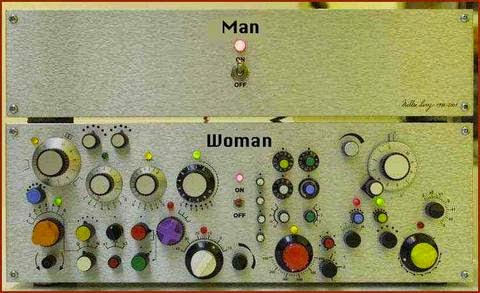
happy valentine's: graphical reminders

Some funny pictures I put in our men's Yahoo group website some 6+ years ago:


Time flies, but the women-men truth remains...
Be sure to: Push the right button, walk the extra mile, and NEVER, EVER try to win an argument with your wife!

Happy Valentine's!

Saturday, February 5, 2011

brain teaser

Without using a calculator -
You are driving a bus from London to Milford Haven in Wales.
In London, 17 people get on the bus.
In Reading, six people get off the bus and nine people get on.
In Swindon, two people get off and four get on.
In Cardiff, 11 people get off and 16 people get on.
In Swansea, three people get off and five poeple get on.
In Camathen, six people get off and three get on.
You then arrive at Milford Haven.
What was the name of the bus driver?
.
.
.
Answer: Oh for goodness sake! It was you, you dummy. Read the first line!!!
See you dummies Saturday!

Saturday, January 22, 2011

facebook

I watched the movie "The Social Network" on the plane back from Taiwan, then saw Mark Zuckerberg's picture on one of the Time magazine issues that arrived while I was away, with the heading "Person of the Year" on it. So, Mark Zuckerberg is the man, and his Facebook revolution the talk of town nowadays, it seems.

Just how big is Facebook today, here are a few tidbits: With 550 million users, it would be the world's 3rd largest nation if it were one, only behind China and India; More people visit Facebook website daily than any other; More and more commercial products get their traffic referral through Facebook than through search engines such as Google or Yahoo... Another interesting statistics is that the fastest growing segment of Facebook users comes from women over 55, and women outnumber men in every age category of Facebook users. Some plausible explanations for such phenomena are women are by nature more social than men and they have found out online social network to be a safe and hassle free environment to conduct such activities; and some "moms" may be tempted to join the network for the possibility of "befriending" their children online when the offline contacts are diminishing.

Like Bill Gates, Mark Zuckerberg is a Harvard dropout. (And he pleged to give away at least half of his wealth, estimated to be $6.9 billion today, over the course of his life time, also following Gates' example). Contrary to what's portrayed in the movie, Mark is not a nerdy, socially awkward young man who uses his extraordinary programming gift to acquire girls, money, and party invitations. In reality, he is sociable and well liked by his staff and partners, and already has a live-in Chinese girl friend who is now a 3rd year med student at UC San Francisco--they met at Harvard 7 years ago, before Mark started Facebook. His mother, a psychiatrist herself, attributes what she calls Mark's "sensitivity" to the fact that he was raised with three sisters. Mark himself majored in both Computer Science and Psychology in college. "For me, computers were always just a way to build good stuff, not like an end in itself." Whereas earlier entrepreneurs looked at the Internet and saw a network of computers, Zuckerberg saw a network of people.

The Internet was built in the 1960's with a decentralized artchitecture that engenders the anarchistic electronic no-man's land nature that allows users to take anonymous or pseudo identities to behave what they normally woudn't in real life--witness the proliferation of online pornographers, hatemongers, scammers, hackers, virus writers, etc. Early social networks like Friendster and Myspace carry on such "origin sin" by allowing malleable and playful identities in their communities as well. But Facebook was and is different. "We're trying to map out what exists in the world," Mark says. "In the world, there's trust. I think as humans we 'parse' the world through the people and relationships we have around us, so at its core, what we are trying to do is map out all of those trust relationships which are colloquially called 'friendships'."

Zuckerberg's vision is that after the Facebookization of the Web, you're no longer canvasing the Web on your own: Wherever you go online, you'll see your friends. On Amazon, you might see your friends' reviews. On YouTube, you might see what your friends watched or see their comments first. Those reviews and comments will be meaningful because you know who wrote them and what your relationship to those authors is. They have a social context. "It's a shift from the wisdom of crowds to the wisdom of friends," says Sandberg, COO of Facebook. Or from "words of mouth" to "words of friends' mouth"--"It doesn't matter if 100,000 people like x. If the three people closest to you like y, you want to see y."

Not that long ago, a post-Google Web was unimaginable, but the time may be near. With the rate it's growing, it's not unimaginable in the foreseeable future every Internet user may have a Facebook account. And the difference between a Facebook user and a Google user? While Google can only guess who its user is and what he/she is insterested in, based on their search history, Facebook knows exactly who they are and what they are interested in, because they told it themselves. In the world of targeted advertising, Facebook has a high-powered sniper rifle, so to speak, and can thus claim more bounty dollars from their advertisers. Now does anyone recall the news over 3 years ago that Google tried to buy off Facebook and was flatout rejected?

So is Facebook the best thing ever happened to Internet? Not everyone agrees. Though it is reinvigorating to know people prefer revealing their authentic selves and sharing socially online than hiding and ranting/shouting uncivil-like behind the Internet veil, the profile we provide in the cyber world is in many ways short of full and complete disclosure of ourselves, and the Internet infrastructure is lacking and even inhibiting in terms of conveying true intimacy that is needed in true friendship that can only be accomplished via real life contacts. If we run our social life fully online, we must be aware of the distortion it may create and the risk of becoming "a genie living within a bottle," where Facebook is the bottle, and we the genie. 

Some more serious criticism on Facebook and its modern day ilks such as Twitter focuses on the new way of communication these social media promote--texting, instant messaging, and that "messages have to be seamless, informal, immediate, personal, simple, minimal and short" philosophy proclaimed by Mark Zuckerberg. As journalist/scholar Neal Gabler says in a recent LA Times opinion article: "The more we text and Twitter and 'friend,' ... the less likely we are to have the habit of mind or the means of expressing ourselves in interesting and complex ways." He also refers to social theorist Marshall McLuhan's book "The Gutenberg Galaxy," in which it posits that the "uniformity, immutability, rigidity, logic" of the print press Gutenberg invented in the 15th century that helped spread literacy throughout Europe also led to the remolding of the human mind, thus the rise of rationalism and of the scientific method. "In facilitating reason, print also facilitated complex ideas," he asserts, and "Print made us think better or, at least, with greater discipline," while "seamless, informal, personal, short...communications lack substances and drive out significant ones." His verdict: "Gutenberg's Revolution left us with a world that was intellectually rich, while Zuckerberg's portends one that is all thumbs and no brains."

That's a bit harsh, don't you think?

Do you Facebook? 

* Do you know: The color scheme of the Facebook logo is blue and white because Zuckerberg is red-green color-blind: there are a lot of colors he can't see, but blue he can see.

Saturday, December 11, 2010

operation OONI

I've been thinking about remodeling my study/home office for a while--since last year, in fact. I've checked new office furniture online and at local stores, invited some home office/closet specialist to measure and estimate, and thought about how to get rid of all the clunky old desk and chairs, bookcases and file cabinets, computer and phones and accessories... But procrastination combined with "do-you-really-want-to-go-thru-such-trouble" second-thinking kept me from acting.

I finally decided to semi-force myself into the "Move-It!" mode the other day: I took a picture of the two main items I wanted to retire--the desk and file cabinet--and put them on Craigslist.com for sale for a meager $40. Within the next two days I got 4 or 5 takers. One woman (most Craigslist shoppers are women, I have found out) offered to come by, as well as a guy who said he lived in the same town and could pick up the furniture that same day. Having been confirmed that I could get rid of my old furniture with relative ease, I wanted to see if I could move more of them out faster than I originally planned. So when the woman came to inspect the furniture and said she would take them (with the help of her son moving), I asked if she'd like to take some other stuff I have--a printer stand, another file cabinet, two bookcases--as well. She declined, so I told her I'll hold the desk and file cabinet for her unless I found someone who would take not only the desk and file cabinet but also my other stuff. On that same afternoon, when the other guy came over to inspect the desk and file cabinet and said he wanted them, I showed him the other furniture and allured him with a low price, and he said he would take them too. So fortunately for me and unfortunately for the woman, I not only sold the desk and file cabinet, but all the other furniture to the guy (Mike) for a total sum of $80. He wanted to haul them all away that day, but I told him he'll have to wait until I get my new furniture, which will be sometime next week. He agreed but asked me to draft a simple purchasing agreement to secure the deal. I did and he gave me $40 for deposit and I promised to call him as soon as I have my new furniture in.

I then went online and ordered a set of new furniture that I had long researched and decided on from Staples, a collection of an L-shaped desk, a hutch, one credenza, one lateral file cabinet, and one bookcase, for a total of around $1400, estimated to arrive the next Tuesday.

Now I needed to hire someone to assemble them--Living in America means some general assembly skill is required of any normal functioning body and I had done my share of assembling with numerous furniture pieces and exercise equipment before, but to do all 5 pieces at one time, I'd rather put my money in good use and delegate it to someone who would excel on that. So I called Staples furniture assembly hotline for quote. They told me for them to send someone to my home to assemble all those 5 pieces will cost me $375 plus tax, to the tune of around $400.

That's a bit hefty to me. So I went online to Craigslist again. Now I have sold quite some stuff through Craigslist throughout the years (indoor/outdoor furniture, barbeque grill, etc.), but have never used any of the self-advertising services there. I went to the web site and looked under the Services section, clicked on the Household category, and did a keyword search for "assembly." Lo and behold, there did come up a few advertisements offering furniture assembling service. I picked a couple and sent them email describing what I needed and asked for quote.

The next day I got a reply from a guy saying he can assemble all 5 pieces for $100.

Now I needed to shop for hardwood floor, to replace my 20+-year-old carpet in the room. There are hardwood floor sales flyers and ads every week from/on LA Times. I picked a couple of them to visit on Saturday, almost made my decision at the second store except I couldn't make up my mind on the wood selection. On Sunday I visited another store, and with more choices there and better knowledge than I had a day ago, and because I liked the pleasant saleswoman there better than the pushy salesman I met the day before, I cut a deal with her and she came over Monday to do the measurement and I paid the deposit for the work scheduled to be done later that week.

The new furniture did arrive on Tuesday as promised--though with one piece missing that was redelivered Wednesday. So I called Mike to come over to pick up the old furniture Wednesday. He came in the afternoon with a guy helper. Within an hour, they skillfully disassembled the old furniture, moved them downstairs piece by piece, heaved them into their two pick-up trucks, without dropping, hitting, or a scratching on the wall. No wonder--In my chatting with him afterwards I found out they are in security alarm installation business and are expanding to set up a new office around here. He paid me the remaining $40 and I threw in (got rid of) a fullback leather chair to him for free.

Now I had a fully empty office room to myself (except for those file folders and wires and cables and miscellaneous accessories in boxes and bags laying on the floor). My original plan was to have the wood floor installed first, to take advantage of the obstruction free situation, then assemble and install the new furniture on the new floor. However, the earliest the flooring company could have their workers come over was Friday morning. So a change of plan was in order. I emailed/called the Craigslist guy to come in Thursday to install the new furniture. He (Doug) showed up on time at 9 AM, a handsome, well built 30 something white guy. I showed him those boxes of furniture laying on the downstair floor, and he immediately got on to work, non-stop, not even for a lunch break, for the rest of the day, untill 7PM, finishing up only 4 pieces of the furniture, though. Poor guy, he had grossly under-estimated the job, I thought to myself while working at my computer--thanks to wireless technology, I was able to move my laptop to the other room and continued working from there without disruption--while he's busy tightening up nuts and bolts, legs and panels, rails and drawers, all the fun pieces of furniture together. I chatted with him later, "This is more than what you think would take (he originally told me it would take him about 3 or 4 hours to finish the job), right?" He seemed a bit embarrassed, but shrugged and said, "A deal is a deal." I liked the honesty and the way he worked, so I said I'll give him $150 instead of $100. He wanted to continue into the night to finish the job, but I told him he'd better come back the next day as we needed to go out for a dinner party that night.

The next day, Friday morning, the floor installers did come on time at 9 AM. They were two Mexican guys, one 30-ish, the other 20-ish. The 30-something seemed to be the lead man and spoke some English. After verifying the order and the physical dimensions, the 30-something left and the 20-something started working. Like yesterday with the furniture installman, I continued to work in the next room while letting him do his at the office room. About half an hour into his work, though, I started hearing him speaking and laughing into his mobile phone, pretty hilariously at times, perhaps having a fun time with his girl friend, I could only guess, because it's all in Spanish. I thought it would let up soon, but instead it kept going on and on, with even more hilarious laughters, interspersed with the vehement banging of his hammer on my floor. I began to worry such phone distraction may affect his work quality and prolong the job--I had scheduled Doug to come in that afternoon to finish the furniture installation. So I went over and did a soft check on him: "Could you tell me when you think you can finish the job today?" I smiled and asked. He was caught a bit surprised by my intrusion, mobile phone still at hand, and seemed genuinely having difficulty understanding my English. After figuring out what I said, he told me in broken English that it should be completed no later than 2 PM that day.

It actually took him till 3 PM to finish the job. But granted this was a smart, capable young man I had here. I was happy with what I saw: neat, elegant looking wood floor just as I imagine it would be. So I gladly paid off the remaining balance and wrote down "Great job!" on the survey paper they were required to ask the customers to fill out at the end of the job.

Doug appeared on time again at 3 PM to start assembling the last and biggest piece of the furniture, the L-shaped desk. Again it took him well into the evening to finish it, and I needed to help him at the end to heave the hutch onto the desk, as well as move the finished furniture around to their right places. I checked the drawers, cabinets, doors, they moved smoothly, aligned perfectly, and no scraches, no dents. This was really a hefty and delicate job, requiring both muscle and brains. I was glad I didn't try to do it myself.

I ended up giving him $180 for the job, the extra $30 in the name of asking him a favor of hauling those empty shipping boxes and debris away for me. He glady accepted the money and diligently pulled and loaded the trash onto his jeep/SUV while Linda and I drove away to another dinner meeting under the sunset...

Operation OONI (Old-furniture Out, New-furniture In) all done, within one week!


PS #1: It just happened that our small group's recent discussion touched on the subject of how the US economy is consumer driven and what would be considered "good" consumption and what not, etc. Well, a modest expense of around $3000 to upgrade a 24-year-old home office that helped create direct jobs for two workers ought not be considered too bad a consumption in this economy, I don't think :) The only little quirky regret I have, though, has to do with a thought I had while thinking about hiring someone to do the furniture assembling: How about that fine young man of my cross-street neighbor's that I only had occasional short chats with through the years. What if I asked him to come over and help me put the furniture together so we can spend time together chatting and working and get to know each other better, and then I give him $200 for the help to help him out a bit on school expenses, his remote control electronics hobby, etc.?

I struck down that idea because deep down in my mind I knew this won't work if my goal is to have the new furniture assembled the fastest and most professional way possible, which unfortunately is what I was after. It seems that in this busy busy world we live in today, we/I value quick, "professional" result over slow, "unprofessional" process, even though that process itself might potentially be a meaningful one.

PS #2: If you have been reading through this borderline over-sharing piece up this point, I guess you probably won't mind seeing some pictures of this new office I've been blasting about, so here they are:


Saturday, November 20, 2010

rick's tweets iii

Sharing some of Pastor Rick's "tweets of wit" with you:

Anytime you're tempted to criticize your spouse's judgment, remember they picked you!

Leaders who laugh, LAST! It flushes stress from your soul.You'll have plenty of material if you laugh at yourself & troubles.

Pride keeps us from listening. Not listening keeps us ignorant. Ignorance keeps us prideful. This cycle hardens the attitudes.

You can't know God thru intellect alone because your brain isn't big enough. But even a child can know him through love.

Great people make others feel great. Small people make others feel small.

I often find that my attitude, like a diaper, requires changing or I stink up the place.

When you take a personal strength for granted, it becomes a weakness without you realizing it.

Whatever sin you're quickest to judge & criticize in others reveals what you secretly hate most about yourself. Rom 2:1-6

Forgetting yourself isnt the final step of love but the first. See 1 Cor 10:24 

I've noticed that before marriage opposites attract but after marrying opposites attack! What was cute becomes annoying.


No one counterfeits $3 bills since they don’t exist. Phony miracles, churches, and believers indicate the genuine is out there.

Jesus began his Church as a FAMILY. It changed to an institution in Rome, a political view in Europe, and a business in America.

FREEDOM is not the absence of limit. It is the POWER God graciously offers you to say YES to what’s right & NO to wrong.

You can IMPRESS people from a distance but can only IMPACT them up close. That requires letting people see your weakness too.

You can learn from anyone--even hypocrites! "So practice and obey what they say but don't follow their example" Matt 23:3

You don’t grow in humility by trying to be humble. Just shift your focus off yourself & on to God's greatness & other's needs.

Until you passionately feel your own continuous need for God's Grace, you'll never convince anyone else they need it.

What right do I have to be angry at others who resist change when there are changes needed in me that I refuse to make?

NEVER interpret God's Word by your experience or logic. ALWAYS interpret your experiences by God's infallible Revelation.  

Many truths in the Bible I only understand by obeying them in faith. Then later, looking back, I can see God's reasons.


Far more will defend the Gospel than will SHARE it, because sharing it takes COURAGEOUS LOVE. Defending just takes knowledge.

Believing the truths of salvation without daily friendship with Jesus is like marriage without intimacy. Possible but not enjoyable.

The Gospel is distorted when REDUCED to a system of beliefs, set of practices, schedule of activities or show of emotions.  

It takes no courage to preach the truth to those already convinced. Courage is loving your enemies so they might know Christ.


Anytime doctrine & duty replace loving Jesus you’ll lose your joy. "I don't want your sacrifices-I want your LOVE!” Hosea 6:6

You can't love people if you're always in your study (or behind a pulpit). Walk with your people today. Listen. Hug. Pray.  

When you expect others to meet needs in your life only God can meet, it's unfair to them & insures disappointment in you.


It's human nature to lie to ourselves. What are you pretending isn't a problem in you? The truth sets you free but it takes courage.

Saturday, November 6, 2010

stuxnet

This is not your grand-pa's computer virus.

Dubbed "Stuxnet," it was discovered in June 2010 by a Belarus-based security company. Unlike ordinary computer virus that hacks consumer PCs or commercial servers, it is written specifically to attack the control of industrial systems made by German electronics conglomerate Siemens that are used in many factory floors, chemical plants, oil refineries, pipelines, and nuclear power plants. Though these industrial control systems themselves don't run on PC, Mac, or Linux operating system, those PCs that supervise them do run Windows. Stuxnet broke into these PCs, found the supervisory control and data acquisition software (SCADA), overrode the execution code with its own malicious one, and caused valves to open, alarms to turn off, safety temperature levels to reset, etc., therefore damaging/sabotaging the targeted operations.

Stuxnet virus had been found mostly in Iran (58.8%), Indonesia (18.2%), India (8.3%), US (1.6%), according to the geotagging of the IP addresses of Stuxnet-infected computers. As a matter of fact, Iran's delay of completion of its Bushehr nuclear power plant was first suspected by the West then confirmed by the Iranian government the result of Stuxnet virus infections. Also, a power glitch in July in the solar panels of India's INSAT-4B satellite causing it to lose half of its transpnding capacity was suspected to be the work of Stuxnet. Both the Iranian power plant and the Indian satellite use Siemens industrial control systems.

Who's behind such an unusual virus? No one knows. But all experts agree a computer virus (or worm) like this requires a broad spectrum of skills and resources to develop and test and spread, and a nation state is the most likely entity with such capacity.

Israeli government has been denying it has anything to do with the Stuxnet virus. But a recent finding of the name referenced by the software (Stuxnet comprises of a 600-kilobyte file and it has not yet been fully analysed) made an interesting twist toward hinting the Jewish state's possible involvement with the virus, with a Biblical clue:

The word in contention is "Myrtus” — which can be read as an allusion to Esther, or the Book of Esther, the Old Testament tale in which the Jews pre-empt a Persian plot to destroy them. If you're wondering how you get Myrtus from Esther ... Esther's original Hebrew name was Hadassah, meaning Myrtle (Myrtus). The project string “b:\myrtus\src\objfre_w2k_x86\i386\guava.pdb” appears in one of Stuxnet's drivers. The guava fruit is part of the Myrtus plant family.

Another nation state named by some as possible origin of Stuxnet is China, for the simple fact that the Chinese government indirectly owns a major share of Asia Satellite Telecommunications Co., which benefited greatly when India's INSAT-4B satellite lost most of its serving capacity and Indian statellite TV service providers had to redirect their customers' statellite dishes toward ASIASAT-5, a Chinese satellite owned and operated by Asia Satellite Telecommunications Co.

No matter who's behind it, Stuxnet is a ground breaking virus not only for its sophistication and scale of operation, but the fact that it is the first computer virus that threatens to cause physical harm through manipulation of infrastructure entities. "Giving an attacker control of industrial systems like a dam, a sewage plant or a power station is extremely unusual and makes this a serious threat with huge real world implications," says Patrick Fitzgerald, senior threat intelligence officer with Symantec. "It has changed everything."

Not necessarily for the good, unfortunately.