Sunday, August 5, 2018

sweet lineing

LINE is an instant messaging service like Skype or Google Hangouts, but used regularly among people with closer ties (old school alums, family members, church group, etc.), it becomes yet another social medium that lures you in for more direct and conversational communication between people you are supposedly more intimate with.

I've joined a few LINE groups in the past couple years, but except for some rare occasions, I've remained an observer much more than become an active participant in group conversations of many kinds

Recently an event in one of my groups--the one consisting of my old junior high school classmates, however, had me totally hooked, day in and day out, clicking and typing, rooting and hooting, for nearly three whole weeks... What was that all about?

It all started with a simple request from one of our old classmates, whose daughter's musical band was in an online popularity contest that needed votes for support: ("Double Sweet" was the name of the band; one vote per person per day was the rule)


​​Our teacher was one of the first to respond:

I jumped in, as many did, as vote #544:

Surprise!, another classmate of ours also had a singer daughter, whose new single just came out, so he invited us to enjoy and "like" it too:   

​Two dads shared how their daughters picked up their singing hobby/career:

​As the daily voting went on, I started picking/waiting for some cool numbers to vote, joshing with my fellow classmates along the way:

​​
We had two natural shifts for voting: As the day turned, those in Taiwan finished their voting, we in the US started ours:

Even the usual social media non-participant, the anti-faddist, non-trend-chaser type were fired up:

I took time to listen to and promote a radio music program hosted by yet another talented classmate of ours, while waiting for my target number to appear:


Friends and family were pulled in by some for reinforcement:

On a business trip to China, one was concerned he might not be able to vote from there (some websites, as well as LINE are blocked in China):

Yes he could and did:

A Twilight Zone moment came when one day our teacher in Taiwan voted, and three of us in US followed, one by one, at exact 10-minute intervals, with no premeditation or conspiration of any sort:

Using the statistics I collected, I did a mid-campaign analysis for the group: In 7 hours (during US day time) our candidate gained 100 votes, while her main rival gained only 5, evidence that ours had far superior foreign legion power than her competition did:
Some in the US set alarm clock to remind themselves to vote when a new voting day started in Taiwan:

We continued to play the game of picking interesting/milestone numbers for vote: 

I waited patiently, then in one fell swoop I grabbed the number (6000) I wanted (I had registered two accounts to be able to cast two votes at a time, using one as a quick setup for the one I was after):

It's the last day of voting, I was staying up late to get the monumental #8000, but some people beat me to it, so I cast my last ballot as vote #8002 and went to bed:


As expected, we won by a landslide: 8118 to 6100 against our closest competitor


​​I made an uncanny hieroglyphical and numerological interpretation for those numbers:


Some gave comments:

What a wonderful LINEing journey! No rude remarks, tiresome posting/repostings, "fake news" nonsense, bad taste jokes or videos, heated but useless political debates... just pure fun and excitement, camaraderie for a common goal, like a bunch of youngsters sitting in one same classroom we were some 45 years ago! 

* Just in case you are curious, here's our classmate's daughter's song that won the contest, for the prize of becoming the official song of a town in northwest Taiwan:

Saturday, July 21, 2018

the baltics

We went on a Baltic cruise in early July. The 9-day sail took us from Copenhagen, Denmark, to a north German coast town, to Tallinn, Estonia, St. Petersburg, Russia, then headed back west to Helsinki, Finland, Stockholm, Sweden, before returning back to Copenhagen, Denmark.


How was it, you may ask. Then here's my super shallow take on the 6 cities we visited:

Copenhagen
Was a very walker friendly city, and the two hotels we stayed in (one before the cruise the other after) were excellently located. We walked our way to the royal palace, the cathedral, the little mermaid, the shopping district... almost all the attraction points I pre-planted on my Google maps, and the city was bright and sun-shiny and blue-watery everywhere. I felt easy coming back to visit again some day.  
 ​


 ​
Berlin
Was 3-hour bus ride away from the north German coast town our ship docked. It's a serious city, with drab buildings and dense Cold War and Nazi histories behind, but also very cultured and vibrant with numerous museums and nouveau sky scrapers in the reclaimed heartland of the city since the fall of the Wall.


Tallinn
Was an unpretentious nice little town that seemed like bringing everyone's life back to the good old (medieval) time, when in reality theirs is a country with a female president and fast becoming the first e-country of the world!


​St. Petersburg
The big-brother city of them all: Extravagant palaces, grand museums, tall cathedrals, endless streets... and gray skies, that seemed to cast a sullen pall on its residents, though I respect and admire the gritty spirit the Russian people must have had, well kept underneath their solemn expressions for centuries.


​Helsinki
Another nice little capital city like its cross strait neighbor Tallinn. Just wished we had had more time strolling and enjoying the lovely tree-lined esplanade park at the heart of the city before being rushed back to the ship.


​​Stockholm
Was another sun-shiny, blue-sky-ish, watery, jovial city I liked. Have a yacht, cruise the river, walk the park, visit a theater, dine at a waterfront restaurant, and the day is still young--the sun won't set until 10 pm! Won't you love living in the Nordics, when it's summer time?


​Europe is an interesting old-world playhouse for human mixture and political conflict studies. Even around a bleak "backwater" little sea like the Baltic (in contrast to the warm, big, civilization birthing Mediterranean), we have had the Viking brothers the Danes and the Swedes vying for supremacy, expanding to convert and conquer the pagan Finns and Estonians in their own version of Christian crusades, before the power of rising Russian Empire put them in check, while merchants of cities around the region continued to do commerce and prosper under the protection of a German organized league of trade for centuries. 

But early Russian polities were established by the Vikings between the 8th-11th centuries, Catherine the Great of tsarian Russia was 100% German, and even though geographically Finland sits right next to its Scandinavian neighbor, ethnically and linguistically the Finns are related to the Estonians across the strait, who in turn are related to the Hungarians in Central Europe...

On a more personal level, one satisfactory thing I got to do in this trip was to visit the birthplace and memorable spots of my hero Danish Christian philosopher, Søren Kierkegaard in Copenhagen. Sitting at the bench opposite his statue in his memorial garden, watching some teen-age kids playing lawn bowls in front of it, care-freely and as-life-goes-on-ly, I wondered if he's still pursuing the incomprehensible, eternal truth he did all his life up there... 


Maybe he still is.

* For more photos and trip narratives, click on the items below:

Friday, June 1, 2018

will you be kind

I love this story Jeff Bezos, founder/CEO of Amazon, told in his commencement speech to the Princeton University graduates some time ago:

As a kid, I spent my summers with my grandparents on their ranch in Texas...  And every few summers, we’d hitch up the Airstream trailer to my grandfather’s car, and join the caravan of 300 other Airstream adventurers.

On one particular trip, I was about 10 years old. I was rolling around in the big bench seat in the back of the car. My grandfather was driving. And my grandmother had the passenger seat. She smoked throughout these trips, and I hated the smell.

At that age, I’d take any excuse to make estimates and do minor arithmetic. I’d calculate our gas mileage -- figure out useless statistics on things like grocery spending. I’d been hearing an ad campaign about smoking. I can’t remember the details, but basically the ad said, every puff of a cigarette takes some number of minutes off of your life: I think it might have been two minutes per puff. At any rate, I decided to do the math for my grandmother. I estimated the number of cigarettes per day, estimated the number of puffs per cigarette and so on. When I was satisfied that I’d come up with a reasonable number, I poked my head into the front of the car, tapped my grandmother on the shoulder, and proudly proclaimed, “At two minutes per puff, you’ve taken nine years off your life!”

I have a vivid memory of what happened, and it was not what I expected. I expected to be applauded for my cleverness and arithmetic skills. “Jeff, you’re so smart. You had to have made some tricky estimates, figure out the number of minutes in a year and do some division.” That’s not what happened.

Instead, my grandmother burst into tears. I sat in the backseat and did not know what to do. My grandfather, who had been driving in silence, pulled over onto the shoulder of the highway. He got out of the car and came around and opened my door and waited for me to follow. Was I in trouble? My grandfather was a highly intelligent, quiet man. He had never said a harsh word to me, and maybe this was to be the first time? Or maybe he would ask that I get back in the car and apologize to my grandmother. I had no experience in this realm with my grandparents and no way to gauge what the consequences might be. We stopped beside the trailer. My grandfather looked at me, and after a bit of silence, he gently and calmly said, “Jeff, one day you’ll understand that it’s harder to be kind than clever.”

What I want to talk to you about today is the difference between gifts and choices. Cleverness is a gift, kindness is a choice. Gifts are easy -- they’re given after all. Choices can be hard. You can seduce yourself with your gifts if you’re not careful, and if you do, it’ll probably be to the detriment of your choices...


It's heartening to know one of the greatest hi-tech visionaries of our times keeps at heart the indelible lesson he learned at youth that values old soft human virtue over young brute computing prowess.

Larry Page, another great hi-tech visionary of our times, whose Google held an honorable "Don't Be Evil" motto and who told his employees when planning their next project to think not just 10% better but 10 times grander, once had a long and spirited debate in a Napa Valley party with Elon Musk--yet another high tech guru of our days but one who holds a diabolic view on AI, according to the book "Life 3.0: Being Human In The Age of Artificial Intelligence" by MIT professor Max Tegmark:

"Larry [said] that digital life is the natural and desirable next step in the cosmic evolution and that if we let digital minds be free rather than try to stop or enslave them the outcome is almost certain to be good... He argued that if life is ever going to spread throughout our galaxy, which he thought it should, then it would need to do so in digital form.

Larry accused Elon of being 'speciesist': treating certain life forms as inferior just because they were silicon-based rather than carbon-based."


Wow, are we supposed to elevate AI/robots to a higher standing and treat them as human equals now?

I think we humans consider ourselves superior to machines because we possess this "humanity" thing machines don't. But what is humanity, anyway--do you think you really know what it is?... Or let's just talk about the "good side" of humanity, such as love, compassion, kindness, etc.... Assuming we do know what they are and have them in us, how much and how often do we show them?... If we don't know what they are or know them but don't show them, isn't that equivalent to we don't have them at all?... How superior are we to the machines then?

See it from another angle: Today's technologies are supposed to liberate us from the mundane, the restricted, group thinking, herd mentality... to become more knowledgeable, communicable, daring, creative... Yet we see instead many people become more inert, entrenched, set in their comfort zone, cyber-cohabiting only with their own ilk, easy-chasing with the latest memes/what's trending on the web, believing what they like to believe with pre-filtered news... losing all the more edges humanity is supposed to hold over the machines...

To end with the ending of Jeff's speech:

How will you use your gifts? What choices will you make?
Will inertia be your guide, or will you follow your passions?
Will you follow dogma, or will you be original?
Will you choose a life of ease, or a life of service and adventure?
Will you wilt under criticism, or will you follow your convictions?
Will you bluff it out when you’re wrong, or will you apologize?
Will you guard your heart against rejection, or will you act when you fall in love?
Will you play it safe, or will you be a little bit swashbuckling?
When it’s tough, will you give up, or will you be relentless?
Will you be a cynic, or will you be a builder?
Will you be clever at the expense of others, or will you be kind?
.
In the end, we are our choices.

Tuesday, May 15, 2018

that mysticism

I saw on a Facebook friend's posting last week while in Taipei that there was a scheduled discussion workshop on "Egocentricity and Mysticism" at a university in the city, and signed up for it since that subject title roused my interest.

It was a university (政治大學) located at the outer part of the town that I had never been to before therefore took me a while--thru subway, taxi, then some leg work--to finally reach its Philosophy Department at the campus.


​The workshop was at the department's library room, a Caucasian lady was sitting there already and smiled at me when I went in. She later introduced herself to be a professor emerita from a liberal arts college in Pennsylvania. A few other "foreigner" scholars stepped in later: Christian was a German philosophy professor teaching at a couple of colleges here, Konstantin was a PhD student from Russia studying philosophy here, and Kai, another German, was the teaching professor at the Department and the organizer of the event.

Our presenter today, Mario, was yet another German, who came from University of Macau, where he taught philosophy and co-translated the book of today's discussion subject from German to English. (Now you know why there were so many Germans here.)

We all had received a few chapters of the book Kai emailed us a few days ago, but Mario still gave us a fairly good summary of the book before the discussion:

Basically, the author (Ernst Tugendhat, a Czech-born German philosopher of Jewish descent) took a unique, somewhat nuanced approach to explain why people take to mysticism as their ultimate world view: Comparing to other animals, we humans are "I-sayers" that speak context independent sentences, which means from the moment we start using language to express ourselves or communicate with others, we possess a sense of self-perspective, the world as a whole (beyond the immediate environment where the speech is made), and the existence of other human beings who have their own self-perspectives as well. 

To achieve the "peace of mind," which seems to be what the author thinks the ultimate goal of life we humans like to pursue, we eventually reach a rational conclusion that the way to do this is to step back from our ego-centered self, accept other human beings' self-perspectives, so to integrate with the world as a whole.

Simple as that, all based on one peculiar human linguistic characteristic, which Christian--who had read the book years ago and apparently was no fan of it--didn't feel convincing enough, and wrote a two page criticism ("Though animals may have no languages like ours, they could still have self consciousness like we do, for example") to share with us, for practically the remaining discussion of the day.

The second discussion session was two days later. This time we focused on the latter part of the book, regarding mysticism, and had another interesting and animated hours-long discussion for a Wednesday morning:

Konstantin raised questions on the subjects of free will and responsibility, crime and punishment... wondering if no punishment should be exerted on persons who act to achieve their goal of prudential good rather than moral good, as Tugendhat seems to argue based on his definition of free will and the affective responses society uses to groom its denizens.
  
Pointing out yet another peculiar approach Tugendhat uses in the book for his arguments, i.e., blending the phenomenological with the analytic, the ineffable with the reasonable, two fundamentally different ways of looking at and explaining the world by Western philosophers since the days of Plato and Aristotle, Kai said the book had been criticized for having done neither too well, though personally he still thought Tugendhat's arguments have merits and the book deserves credit for the efforts he puts in.

Mario agreed there are holes and loose ends in this "I-sayer" theory of Tugendhat's. For example, it was criticized heavily by German Christian community for its summary dismissal of monotheist religions (such as Judaism and Christianity) as purely contractual giver-taker relationships between God and the believers, ignoring the Western mystical traditions within the church; Does the "I-sayer" theory hold true for people whose language has radically different linguistic characteristics, e.g., with no personal pronouns? Is the peace of mind the ultimate goal of life?... etc.

Gustav, the guy I met a couple years ago through some business encounter and was a PhD graduate from the university, chimed in to clarify what he thought the book misleads about Buddhism's view on suffering and ways to be relieved from it: Buddhism is not an escapism from suffering, he said, but rather a practice to go right into it to eliminate it!


The question I raised, on the other hand, was regarding the "universal love" Tugendhat claims this rational mysticism would lead to. How could that happen? I looked through the chapters I had at hand and could only surmise that by stepping back and seeing one's self and others' as one, one would want others to be good as one wants oneself to be good. Also, from this passage on the book: "Where else would such kindheartedness...come from? It is not a genuinely moral concept; nor is kindheartedness to be understood as a genetic disposition. If some people give the impression that they possess kindheartedness 'by nature,' this apparent naturalness arises rather from the fact that the possibility of cultivating a mystical outlook—by stepping back from oneself—is rooted in the natural structure of I-sayers," I thought Tugendhat believes there is a built-in tendency to be a mystic in every human being.

Kathleen, the professor emerita from Pennsylvania I met first, contemplated on the dialogue form of discussion that ancient philosophers, most famously Plato and Socrates, had taken while searching for truths. "Could that be somehow called a 'kindheartedness relationship' as well?... Take us, as an example... two days ago we were all strangers to each other, but now after these discussions and exchanges, we kind of create a bonding, and the dialogue may continue on after we part from each other... Maybe mystics are people who continue to dialogue..." I really liked her way of thinking and saying it!


Time went by swiftly as we dialogued on, and we had to wrap up our meeting a few minutes ahead of schedule as Mario had to leave for the airport for his flight home to Macau, and I, too, for my flight back to California. I had a few words with my friend Gustav, thanking him for posting the event on his Facebook page so I got to come to such an interesting event, then a few words with Kathleen, saying I quite enjoyed her talk and got a business card from her and bid farewell to each other and went on our separate ways...



Sunday, April 22, 2018

two lakes and a mountain

A three and a half hour flight took us from Taipei to an obscure little town in rural Japan northeast... and we saw

two lakes and a mountain

That obscure little town we landed on was located in the largest but least populated county of Japan, with a 6500-foot-tall snow capped volcano mountain nicknamed "Mt. Fuji of northeast Japan", that could hardly escape our sight while we toured around it and two neighboring counties over the next few days.


​A big deep crater lake to its south glittered and glimmered with a golden lady statue under the cold and haughty skies; another, far to the north on a lower terrain, was calm and classy against canopy blue, approachable and multi-faceted as we strolled around it.


stream for hike and stream for ride

Out of that calm and classy lake flew a quiet little creek, crossing a maple woodland, chaperoned by a miles long hiking trail and a few splattering water falls on its sides; then there was this other peaceful river that we floated on, in a straw-lined gondola, gliding past its ragged rock walls and drooping tree vines, listening to the operatic Japanese folk song singing by the gondola handler...
 ​


two old railways 

Led us through the rural farm lands for its season changing landscapes that happened to be brown and languid at this time of the year; some serendipitous catch of random scenes of beauty along the bus routes more than made up for the lackluster views from the trains, however.


one great snow wall

You may have heard a weatherman forecasting a severe winter storm that might bring a "3 feet snow fall" with it, but did you ever see a wall of 15 foot tall snow piled up along the side of the road, on both sides, stretching for miles? That's what we did when our bus drove through the mountain range around Mt. Fuji of the northeast in one sunny afternoon!


​​temples, castles, and samurai homes

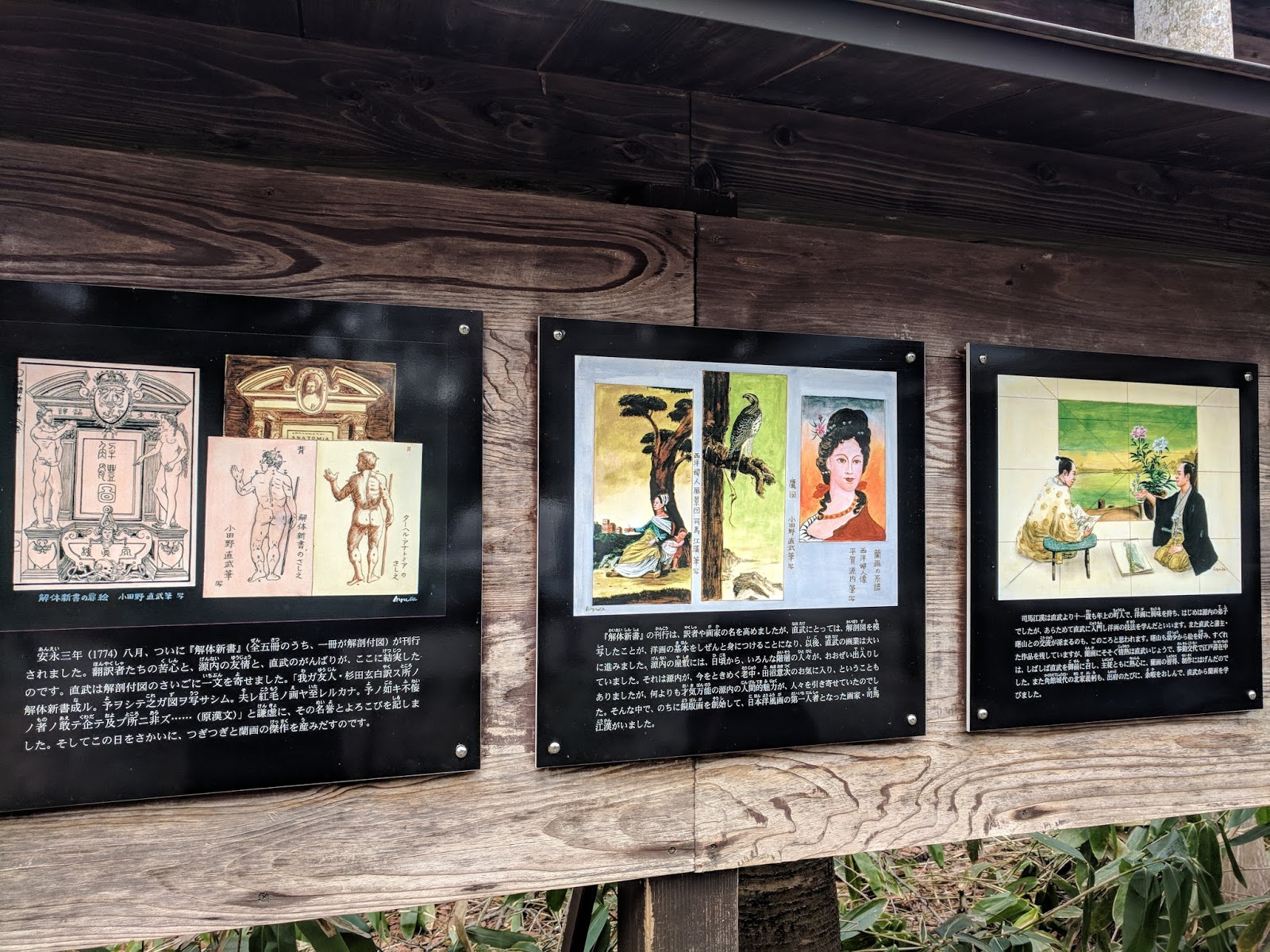
A millennium year old temple housed a gold plated altar for Buddha and four generations of the regional warlords of old time Japan; one of the 12 remaining grand castles of Japan was setting up to be the fairground for the coming yearly cherry blossom festival; a grand samurai mansion is now an open museum that hosts not only samurai swords and costumes, but phonographs and anatomic paintings that evidence the westernization of Japan in the late 19th century.


hotels and onsens

All the three hotels we stayed in featured traditional Japanese style rooms, with tatami mats and low tea tables, and indoor and outdoor hot spring ("onsen", as the Japanese call it) bath chambers. The hot springs came from natural sources but smelled no sulfuric odor and looked crystal clear clean. I took the "hot soup" dip every early morning for the first two days, then in the evening also for the last two days once I got addicted to it! 


food, people, and shop 'til you drop

Exquisite Japanese food, be it pre-arranged on a set plate or self-picked from the hotel buffet trolley, gave great satisfactory taste without stuffy feel, and was healthier than western diets, in my opinion, notwithstanding the fact I gained a few pounds after the trip.

We went with a group of 34 and knew a few of them at the end of this 5-day-short tour, like this one guy who might well be a tour guide himself explaining to us which six counties constitute the Japan northeast; another, owner of a flower arranging business, on how to tell different cherry trees apart by looking at the shapes and forms of their flowering buds...

And there were these two ladies, cousins between themselves, one a beauty salon owner the other a project manager at a major business software company, took every opportunity to shop--at the mall, the drug store, the super market, etc., and even had some items they ordered online before the tour ship to the hotel for themselves to pick up and carry home... They were so overloaded with the stuff they bought my kind-hearted wife offered them some of our airline check-in quota so they wouldn't get charged for the excessive luggage they needed to get on board!

Great food, beautiful scenery, convenient transportation, friendly Japanese, quality services, value shopping... I am now beginning to understand why so many Taiwanese love traveling to Japan so much so often!

* For more photos and chronological notes for the tour:

* For the drive through snow walls:

Friday, March 30, 2018

quanta quanta

Quantum mechanics has been a "weird science" to me since my college days, when as Electrical Engineering major we were required to study it as part of our "modern physics" curriculum, the theoretic foundation for semiconductor electronics that makes up the backbone of the digital technologies today.

Weird as they seem, the following "quantum phenomena", in layman's terms, have been widely observed and lab proven to be as true and indisputable as ever:

Quantum Duality: An object can behave like a particle or like a wave

Quantum Uncertainty: An object's exact location and/or movement can only be measured up to a certain accuracy

Quantum Superposition: An object can be both here and there, or anywhere; a "wave function" can only be used to predict how likely it might appear somewhere 

Quantum Entanglement: Two objects' states can be somehow related or complementary to each other even though they are spatially separated 

Non-locality: Objects can have instantaneous communication without any exchange of signals through space-time

De-coherence: An object can lose its superposition ambiguity and "collapse" into a specific time and space of the "classic" world

Also, instead of the "two physics" scenario that uses classic (Newtonian) physics to describe the macro world we encounter in our everyday life, and quantum physics for the sub-atomic, micro world where photons and electrons behave, more people nowadays agree that the latter--quantum physics--is the single physics that can describe both the macro and micro worlds in one comprehensive theory. 

Which means, for example, even the moon is a quantum object; it's just so massive that its quantum uncertainty and wave property become so minuscule and negligible that we can treat it like a classical object, just like we can look at the area around us and think it's flat even though we know the Earth as a whole is round.  

Now, the million dollar question, "What causes a quantum object to de-cohere, to shake off its quantum ambiguity and pop into a classic-world being?"

The "observation" does it, experiments say.

What is an "observation"?

It's a measurement by one or a few physical apparatuses such as photon splitting mirror, detecting screen, etc., that is eventually observed by the perceiving mind of a human being.

So a human mind is involved with the behavior of the last, tiniest pieces of matter of the world, when it all comes down to it?!

Western philosophers and metaphysical and ontological thinkers--people who have been pondering on the issues of what the universe is made of, the nature of things, the human conditions--have long adopted a dualistic view that treats mind and matter, soul and body, as two separate entities; or a monistic but materialistic view that sees the mind as the epiphenomenon--the emergent phenomenon or derived effect--of the matter, especially since the Enlightenment times and along with the development of modern sciences.

But what if it's the other way around, that mind is the real thing, and matter is the derivative or the emergent phenomenon of it?

Imagine one unitive, omnipresent consciousness, roaming in a quantum universe, drawn and exercised by every sentient being, to knock the ever-so-elusive quantum objects it pays attention to into concrete, material existence... 

And since all sentient beings share one unitive consciousness, once an object is materialized by your consciousness it is perceived similarly by me as well (so you won't see a dead cat while I see it as alive); and collectively our consciousness forms some universal psyches, or the so-called "unconscious archetypes" suggested by Carl Jung.

The consciousness has absolute latitude in choosing what state to crash things into existence (thus our free will), but such choosing takes active efforts (awareness, contemplation) to execute, and due to our inertia or myriad of previous choices we made in similar situations we keep in our mental store, we tend to instantiate the "old and true" ways of thinking and live life as one routine after another.

However, once in a while, a brisk, eruptive "quantum jump" of our conscious choice triggers a creative thinking that gives rise to our aha moments in life!

Paranormal experiences, such as telepathy, distant viewing, extra sensory perception (ESP), etc., could be instances where the non-local (transcending space-time) communication between entangled parties is at work.

Far fetched? All these just another fancy way of explaining many phenomena we observe in the world--another "poetic naturalism" talk, except this time it tells the story from the mind's vantage point instead of the matter's, like the naturalists usually do?

It might well be. But as a sentient being myself, I must say I hold an inborn bias that rather gives the mind an upper hand over the matter, than the other way around 

And have you heard of the "quantum computers" companies like Google and IBM are building? They make use of the multi-possibilities of the superposition state of the "quantum bits" to do super fast parallel processing, and the non-local communication between entangled secret keys to create unbreachable encryptions!

Even in the field of psychological study, they find some quantum truth in human behavior. "The making of a decision collapses a thought wave into a particle," according to Jerome Busemeyer and Peter Bruza’s book "Quantum Models of Cognition and Decision". "The wave nature of an indefinite state captures the psychological experience of conflict, ambiguity, confusion, and uncertainty; the particle nature of a definite state captures the psychological experience of conflict resolution, decision, and certainty," they write.  

So, for example, if I’m telling a friend about a "Man of the Year" award I am about to receive, and I’m not sure how I feel about it, if he asks me “Are you nervous?” that might get me thinking about all the reasons I should be nervous. I might not have been nervous before he asked me, but after the question, my answer might become, “Well, I am now!”

You might know nothing about quantum physics before, but you do now 