Wednesday, October 2, 2013

men, stars, earth, sun, and pope

A couple of recent remarks by the new Pope Francis turned some heads these days: On the plane back from Brazil, he told reporters "If someone is gay and he searches for the Lord and has good will, who am I to judge?” and in a letter to an Italian newspaper he wrote “You ask me if the God of the Christians forgives those who don’t believe and who don’t seek the faith. I start by saying – and this is the fundamental thing – that God’s mercy has no limits if you go to him with a sincere and contrite heart. The issue for those who do not believe in God is to obey their conscience."

Long perceived as the stodgy, gloomy, ultra-conservative old guard of Christian faith, you might be surprised, but such remarks are in total agreement with the Catholic Church's doctrinal stand for at least the past 50 years, if not longer. In the Vatican II Council (1962-1965)'s "Dogmatic Constitution on the Church" it states:

"Those also can attain to salvation who through no fault of their own do not know the Gospel of Christ or His Church, yet sincerely seek God and moved by grace strive by their deeds to do His will as it is known to them through the dictates of conscience."

Sounds a bit drab and stuffy still, but quite a contrast to the bible thumping "believe or burn in hell" shouts coming from some Evangelical Protestants sometimes.

The Catholic Church is also often times accused of anti-rationalism and suppressing scientific development throughout the Medieval Europe period (500-1500 AD), the so-called Dark Ages between the end of Western Roman Empire and the beginning of Renaissance and modern Age of Enlightenment.

The truth of the matter is even though early Christianity did have concern about "pagan knowledge" from the Greek philosophers and their Roman successors, it soon accepted that just as God had given the Jews a special insight into spiritual matters, so He had given the Greeks a particular insight into things scientific, and that if the cosmos was the product of a rational God then it could and should be apprehended rationally. Throughout medieval history, the Church was actually the greatest promoter and sponsor of early universities and "natural philosophy" study all over Europe and laying the foundations for the rise of modern science as we know it, according to historical records and scholastic studies.

How about that infamous "trial of the century" "Religion vs Science" persecution against the great astronomer/physicist Galileo, that the all-mighty Church going after one scientific purist who insisted on saying that "the earth circles the sun" (the heliocentric theory), rather than the long held "the sun circles the earth" (the geocentric theory) view of the world?

To begin with, Galileo did not "invent" the heliocentric theory, nor was he the first to propose it. It was proposed by another astronomer/mathematician Copernicus 32 years before he was born, and was among a few world models suggested by many "natural philosophers" (later called "scientists") at that time. What Galileo brought into the debate was his observation through his telescope (that he did invent) of the phases of Venus and satellites orbiting Jupiter. 

Due to the lack of convincing evidences and opposition from many of fellow natural scientists at that time, the Church decided to stand by its traditional geocentric position--which incidentally was one of the pagan Aristotelian ideas that the early Church adopted--and ordered Galileo in 1616 not to "hold, teach, or defend in any manner" the Copernican theory regarding the motion of the earth. Galileo obeyed the order for seven years, partly to make life easier and partly because he was a devoted Catholic.

Things made an interesting turn, however, when Galileo's long time friend and admirer Cardinal Maffeo Barberini became Pope Urban VIII in 1623. He allowed Galileo to pursue his work on astronomy and even encouraged him to publish it, on condition it be objective and not advocate Copernican theory. In 1632, Galileo published a book titled "Dialogue Concerning the Two Chief World Systems", in which he used three fictional characters engaging in an imaginary conversation. One character, who would support Galileo's side of the argument, was brilliant. Another character would be open to either side of the argument. The final character, with a pejorative name Simplicio ("fool" in Italian), was dogmatic and foolish, representing all of Galileo's enemies who ignored any evidence that Galileo was right. Worse yet, whether knowingly or deliberately, Galileo put some of the arguments used by Urban VIII into the mouth of Simplicio. 

Angered by this, the Pope effectively withdrew his support for Galileo and allowed him to be tried by the Inquisition for breaking his agreement of 1616 in the way he argued in the Dialogue. The Inquisition found that he had and he was punished for this. He was placed under house arrest in his villa in Florence for the remaining nine years of his life, where he completed several of his most important works before he died. 

In retrospect, the Catholic Church did not (and does not) teach that the Bible had to be interpreted literally. The Catholic Church, then and now, taught that any given Bible verse or passage could be interpreted via no less than four levels of exegesis--the literal, the allegorical/symbolic, the moral and the eschatological. Of these, the literal meaning was generally regarded as the least important. This also meant that a verse of Scriptures could be interpreted via one or more of these levels and it could potentially have no literal meaning at all and be purely metaphorical or symbolic.

All this means that the Church was quite capable of changing its interpretations of Scriptures that seemed to say the earth was "fixed" (e.g., Psalms 104:5 says "The Lord set the earth on its foundations; it can never be moved."; Ecclesiastes 1:5 states that "The sun rises and the sun sets, and hurries back to where it rises.") if it could be shown that this was not literally the case. It just was not going to do so before this was demonstrated conclusively--something Galileo had not done. As Cardinal Bellarmine, who was a well qualified natural philosopher himself and acquainted with the state of the heliocentric/geocentric debate, as many of the clergymen were at that time, noted in his 1616 ruling on Galileo's writings:

"If there were a true demonstration that the sun is at the centre of the world and the earth in the third heaven, and that the sun does not circle the earth but the earth circles the sun, then one would have to proceed with great care in explaining the Scriptures that appear contrary, and say rather that we do not understand them than that what is demonstrated is false. But this is not a thing to be done in haste, and as for myself I shall not believe that there are such proofs until they are shown to me."

In conclusion, the Galileo affair was a complex series of events that involved a lot more than just science and religion. It occurred during the aftermath of the Protestant Reformation when the Church needed to re-assert its authority, between a brilliant but at times arrogant and abrasive man and his jealous fellow scientists, and last but not least, his unnecessary snub and humiliation of a personal and political ally, the "infallible" but all-so-human Pope of the day!

Friday, August 16, 2013

and an anniversary

Tim and I went to the same elementary school in Taipei, then the same private junior high, public senior high, and then the same grand old university in Taiwan. Other than that, honestly, we didn’t go that close. He’s more like a jock while I leaned more toward the nerdy side, to borrow kid’s term today. Our paths may never cross after we graduated from school, just like many other people we met in life.

But fate has a mysterious way of bringing us together. Just after I came back from my wife’s high school reunion cruise in New York a couple years ago, he called me out of the blue. What happened was I took a picture with a group of guys who accompanied their wives to the reunion just like I did, and one of them happened to be acquainted with and lived in the same neighborhood in Northern California as Tim. He spotted me right off the picture and got a hold of my contact info through him, thus we reconnected with each other.

He’s been coming to Southern California on occasions since and I met him and his wife about every time they came. He’s a super energetic guy, and very athletic: He surfs and bikes, knows every nook and cranny of Southern California coast more than I do. And he has a tremendous memory: he can spew out names of our high school teachers and classmates, down to the berth tag numbers of our dorm room, without a second’s hesitation. Plus all the little details of the crazy things he did during those young and restless years of his, of course.

He came in town a couple weeks ago again, this time from Hawaii after returning from Taiwan visiting his sick-bed ridden father. And as usual, he found time in his tight, dynamic schedule here to come down to my home for biking and boogie board surfing, along the harbor and on the beach, in early morning and late afternoon, Saturday and Monday. He wanted me to come boogie boarding with him again Tuesday in Newport Beach, “where the surf is better,” he said. I would if not for an urgent Website cut-over my project happened to be in.

“I am retiring at the end of this month,” he told me when I half-jokingly checked about his retirement plan when we met this time. Though he mentioned a couple of times before that he would retire right after 55, I was a little surprised he’s actually going to do it now. 

What would you do after you retired, I asked him. He said he’ll spend 8 months in Taiwan every year, to care for his father, who has been in vegetative state for over the past 20 years and for whom he flew back every year using up his vacation time just to be able to sit next to him in the hospital. He said he’ll rent an apartment near the hospital so he can walk to the ward every day. And “I may be able to spread Gospel in the hospital too,” he smiled. He’s a devout, compassionate Christian brother, by the way. More the “prodigal son” type than the up-tight one, you know.

I admire his energy, devotion, and genuine affections towards people. People like him make us connect and reconnect, explore and expand, and enjoy the fun in life. God bless him and his family, and may we all have more biking and surfing together for years to come—even though my feet hurt badly after that first ever boogie boarding of my life the other day.


The above picture was taken after the celebration dinner for Tim and his wife’s 25th anniversary at his cousin's home in Irvine. Tim is the 3rd from the left in the back, standing right behind his wife Lily.

Long live marriage, friendship, love, hope, and faith in all these and beyond.

Thursday, August 15, 2013

an accident

I had been driving a Toyota Highlander for over 5 years. Happy with it, everything ran smooth and swell, and I kept it in great shape, as if I would keep it forever. I might as well do, except I met my childhood friend Sunny one day last month when he came back from his factories in China and Vietnam and asked me for a little get-together at his office.

“Sell me your car,” he practically yelled at me when he saw me and my Highlander. Why? “This car is ideal for my factory in Vietnam. It’s a 7-seater, in good shape, isn’t it?” he said. “I’ll pay you Kelley's Blue Book full price for it,” he added.

My first reaction was bewilderment and rejection: Why would I part with my good, old-but-still-shiny-looking, reliable SUV and replace it with… what? I have to admit, when it comes to cars, I am not one of those who always dream of or plan on what their next fancy one would be.

But a thought had snuck into my mind. Long story short, I started shopping for a new car after I confirmed with Sunny I would sell and he would buy my Highlander to export to Vietnam as he proposed, and finally landed my eyes on and purchased a BMW X3, a “German engineered” cross-over that brings back the driving sensation I used to have with a Mercedes I owned a few years ago. The funny twist of event was my Highlander ended up not sold to Sunny, because the Vietnamese government told us at the last minute that they won’t allow import of any cars older than 5 years (and mine was just 3 months over the edge), but traded in to the BMW dealer I bought my X3 from.

All is dandy and fun, nonetheless. I enjoy the handling and the bells and whistles that come with a new car, and my wife loves the look and the nice LED lights that automatically shine up before doors are opened.

Then a couple of weekends ago, we had a little party at our home with some friends of new and old, and we decided to go to the nearby beach for a stroll. I had in my new BMW full load of 4 ladies. Yakety merrily they chatted all the way, and just a couple of blocks before we reached our destination, on an ascending slope of the busy Pacific Coast Highway, the car gave up on me: All of a sudden I lost power, it couldn’t accelerate, and started slowing down. Within seconds all I could do was veer the car to the left-turn lane, where it stopped completely, and the navigation screen lit with the message “Drive train malfunction…”

My friend, who drove another car following me with another full load of people, called me from his cell, asking me what’s going on. I told him I had car trouble and asked him to drop off his passengers at the beach park ahead then come back to pick up mine. Then I pressed the “SOS” button on the headliner right above my driver seat, pretty James-Bond-movie like, and made an “Emergency Request” call, as the complimentary BMW road side assistance service is named.

The BMW operator got online right away and identified me and my vehicle and where I was, then instructed me to stay there for a tow truck to come in about 30 minutes.

A Good Samaritan on his bike approached me and asked if I could put the car in neutral gear so he could help push it out of the middle of the road. “Otherwise those cars are going to hit you from behind,” he said, pointing to the phalanx of vehicles whooshing by. Unfortunately the gear wouldn’t shift because it’s electronically locked dead already, so I thanked him and he left. A police patrol came minutes later, and after a few friendly chats with me, understanding what happened, he summoned another police car, whose officer had on his uniform inscribed “Community Service” and started putting those little red fiery torches on the road to block out the lane, potentially preventing cars from hitting me and my car…

I got a call the next day from the BMW dealership where my car was towed. “What was wrong with your car?” he asked. I told him it quit on me right in the middle of the road and the engine wouldn’t run and the transmission wouldn’t shift. “Well it’s running perfectly fine here now after I put a couple gallons of gas in its tank,” said the worker. I couldn't believe it. The car’s fuel was at its tank bottom yesterday, as its gauge indicated, I knew, and though I thought about refueling it in the morning I got side tracked and decided to do it later, as often the case. But could it be as simple a cause as that? Don’t the gauges usually lie when it tells you you have no gas in the tank when in fact you still have a good one or two gallons left to go for another 20, 30 miles or so?

I picked up my X3 and told my friend about this the next day. He laughed and postulated maybe it was indeed the case: that my car was running very low on fuel, and when it went on an uphill climb as happened that day, it had trouble siphoning up the fuel from the tank due to the tilt, therefore it died.


The above picture was taken by the young community service police officer who spread the safety torches on the road for me. I joked with him that if I post this photo on my Facebook or Twitter page, “it would be bad publicity for BMW,” and he laughed in total agreement with me. But no, BMW, I bear no ill will against you and am still in love with my new X3, and your emergency service is every bit you advertise it to be. Just hope I won't have to use it any more.

I have to apologize to those ladies in my car for the scare, though. But rest assured, I had already got my earful of condemnation from my wife, even for the yet to be 100% proven theory that the cause of this (unnecessary) accident was due to the negligence on my part!

Wednesday, August 14, 2013

a wedding

Ray is a buddy friend of mine since college. His first born child, Michael, who actually came to this world 26 years ago the same year we and Ray and his wife moved down to Orange County and whom we practically watched grow from toddler to boy, to a Stanford graduate and then a mature young adult working in Wall Street, New York, was getting married. We were invited to his wedding held in Park City, Utah last month.

As is customary here, the wedding was planned months ahead by the jolly young couple and "sponsored" by the bride's family. The bridegroom side's family and guests basically just need to "show up for the show," so to speak. But Ray and his wife Jenny being such nice people, they booked and paid the hotel rooms for us beforehand, so all we really need to do as guests was to plan and book the airline tickets to Utah months ahead and show up with good will and jolly mood for the occasion.

We arrived in Salt Lake City one day before the wedding, took time for a little tour at the downtown, visiting the Mormon temples and museums, then headed back on the highway to Park City about 45 minutes away.

Park City is a (winter) resort town, famous for its many splendid ski runways, and was the host city of the Winter Olympics Games in 2002. Me and my wife had been here before, but only as occasional tourists. Now we'd stay for the next two nights at one of its more prestigious hotels, St. Regis, to enjoy its beautiful outdoors and scenery, and the grand wedding.

The wedding program actually started the night we arrived, at an old Western bar in downtown Park City. All guests were encouraged to dress up as cowboys and cowgirls, and a hired country & western band played music and taught all how to line-dance, with beers and drinks and desserts and walls flashing with pictures of the bride's and the bridegroom's, etc. We got to meet Michael and his soon-to-be wife, Parilee, at the bar as well. Parilee is a young, (relatively) tiny Caucasian girl we met briefly once in Taipei last year, who looked spritely different tonight. Dressed in white, elegant gown, greeting and embracing every guest with pleasantry and passion, she looked more like a typical, well cultivated middle class American family hostess than the quiet, shy little young woman we met last time. We took turn to take pictures with them and other guests, then chatted, drank, and (I) had quite some delicious chocolate fondu, before heading back to the hotel in the shuttle provided near mid-night.

The next day started with a casual brunch buffet at the hotel. Afterwards, I went for biking in the wild and my wife for shopping at downtown for the afternoon, to each his/her own heart's content. Then we got back to the hotel to get ready for the wedding.

The ceremony was held outdoor, in the mountain-canopied garden of the hotel. Luckily the weather was cloudy enough to be cool, yet not too moist for the rain or drizzle to appear. The officiant of the ceremony was interestingly the grandfather of Parilee's, a sagely and humorous gentleman who seemed well versed in world affairs than most American people I know. He said as the first grandchild of their family, Parilee had been outstanding in every aspect since a kid. She earned 5 top awards out of 10 when she graduated from school, with a Taikwando black belt on the side. Naturally they all wanted the best for her, and were intrigued when she picked Michael as her life partner. But then Michael proved to be as brilliant in his own way as she is, and they couldn't be happier for both of them now. Then Parilee's and Michael's best friends spoke in turn at the podium, including one young man reciting a Chinese poem from 詩經 (窈窕淑女,君子好逑), whose well done English translation was printed on the back of the wedding's official program for all to view.

What touched me most, though, was at the end when Michael and Parilee exchanged their vows to each other. You may say they were just love promises from two passionate young man and woman at the consummation of their long term courtship, but I could tell the words came from their hearts and they meant every ounce it carried. "I promise you, Michael, no matter what lies ahead in our life together, our family will always be my first priority," says Parilee, a modern female, raised in a very well-to-do family, graduates from Stanford and Harvard, with a great professional career ahead of her, still subscribing to the good old value of marriage whole-heartedly. Amazing!


The politically correct question for a husband to ask with regards to this picture is: Ignoring the dresses they wear, can you tell which lady in the picture is my wife, and which other is the bride?

Thursday, July 11, 2013

enlightenment 2.0

I'll call it "When High-Tech meets Ole Wiss(dom)," but did you know there are over 1000 and hundreds of Google employees who have attended or waiting to attend company sponsored meditation and mindfulness classes; Facebook is experimenting and following ancient and modern-day sages' advices to instill more humane ingredients in its service to 1 billion netizens over the world; some self-taught enlightenment achievers in the Valley think the way to Nirvana is here and now and its knowledge and practice should be open and sharable to all as much as possible, hence the "open source enlightenment" movement through web sites and mobile apps. And this being the Silicon Valley, there is an annual "trade event" called "Wisdom 2.0" ("How do we live with greater awareness, wisdom, and compassion in the digital age?") whose attendance has jumped up five folds since inception in 2010... All these are covered in a report titled "Enlightenment-Engineer" in the July issue of WIRED magazine. The following are some excerpts:

Google's on-campus "emotional intelligence" training class--called "Search Inside Yourself"--was started by Chade-Meng Tan, a Singapore born engineer who joined Google in 2000 as employee number 107 working on mobile search. He got turned on to Buddhism by an American nun and for years his attempts to bring meditation into the office had been met with limited success. It was only in 2007, when he packaged contemplative practices in the wrapper of emotional intelligence, that he saw demand spike. Now there are dozens of employee development programs at Google that incorporate some aspect of meditation or mindfulness, including a bimonthly series of “mindful lunches,” conducted in complete silence except for the ringing of prayer bells, which began after the Zen monk Thick Nhat Hanh visited in 2011. The search giant even recently built a labyrinth for walking meditations.

It’s not just Google that’s embracing Eastern traditions. Across the Valley, quiet contemplation is seen as the new caffeine, the fuel that allegedly unlocks productivity and creative bursts. Classes in meditation and mindfulness—paying close, nonjudgmental attention—have become staples at many of the region’s most prominent companies. There’s a Search Inside Yourself Leadership Institute now teaching the Google meditation method to whoever wants it. The co-founders of Twitter and Facebook have made contemplative practices key features of their new enterprises, holding regular in-office meditation sessions and arranging for work routines that maximize mindfulness.

Repeated studies have demonstrated that meditation can rewire how the brain responds to stress. Boston University researchers showed that after as little as three and a half hours of meditation training, subjects tend to react less to emotionally charged images. Other research suggests that meditation improves working memory and executive function. And several studies of long-term practitioners show an increased ability to concentrate on fast-changing stimuli. One paper cited by the Google crew even implies that meditators are more resistant to the flu.

But Googlers don’t take up meditation just to keep away the sniffles or get a grip on their emotions. They are also using it to understand their coworkers’ motivations, to cultivate their own “emotional intelligence”—a characteristic that tends to be in short supply among the engineering set. There is in fact little data to support the notion that meditation is good for Google’s bottom line, just a few studies from outfits like the Conference Board showing that emotionally connected employees tend to remain at their current workplaces. Still, the company already tends to its employees’ physical needs with onsite gyms, subsidized massages, and free organic meals to keep them productive. Why not help them search for meaning and emotional connection as well?

Search Inside Yourself might have remained a somewhat isolated phenomenon in the Valley if a mindfulness instructor named Soren Gordhamer hadn’t found himself divorced, broke, out of a job, and stuck in the town of Dixon, New Mexico (population 1,500). Gordhamer, who had spent years teaching yoga and meditation in New York City’s juvenile detention centers, was feeling increasingly beleaguered by his seemingly uncontrollable Twitter habit. He decided to write a book—Wisdom 2.0: Ancient Secrets for the Creative and Constantly Connected—that offered tips for using technology in a mindful manner. By providing constant access to email, tweets, and Facebook updates, smartphones keep users distracted, exploiting the same psychological vulnerability as slot machines: predictable input and random payouts. They feed a sense that any pull of the lever, or Facebook refresh, could result in an information jackpot.

So he got the idea to host a conference where the technology and contemplative communities could hash out the best ways to incorporate these tools into our lives—and keep them from taking over. The event, billed as Wisdom 2.0, was born in April 2010 and the attendance has shot up 500 percent in 3 years. In 2013 nearly 1,700 signed up to hear headliners like Arianna Huffington, LinkedIn CEO Jeff Weiner, Twitter cofounder Evan Williams, and, of course, Meng talk about how they run their enterprises mindfully. 

One of the reasons that Wisdom 2.0—and the broader movement it represents—has become so big, so quickly, is that it stripped away the dogma and religious trappings. But it’s hard not to consider what gets lost in this whittling process. Gautama Buddha famously abandoned the trappings of royalty to sit under the Bodhi Tree and preach about the illusion of the ego. Seeing the mega-rich take the stage to trumpet his practices is a bit jarring. It also raises the uncomfortable possibility that these ancient teachings are being used to reinforce some of modern society’s uglier inequalities. Looking around Wisdom 2.0, meditation starts to seem a lot like another secret handshake to join the club. “There is some legitimate interest among business people in contemplative practice,” Kenneth Folk says. “But Wisdom 2.0? That’s a networking opportunity with a light dressing of Buddhism.” And several established Buddhist leaders who came to this year’s conference were openly wary of what they saw as an unhealthy fixation on the brass ring of enlightenment. “If someone really wants it, I’ll teach it,” says Kornfield, cofounder of the Spirit Rock Meditation Center north of San Francisco. “But a strong goal orientation can heighten unhealthy ambition and self-criticism. It doesn’t really heighten wisdom.”

Arturo Bejar, an engineering director at Facebook who was a reluctant guest at the first Wisdom 2.0 conference in 2010, but changed his mind after witnessing an onstage conversation about kindness with American Buddhist trailblazer Jon Kabat-Zinn: "If people truly see one another," Kabat-Zinn said, "they’re more likely to be empathetic and gentle toward each other." Bejar then began looking for ways to bring some of that compassion to Facebook, where bullying and flame wars were all too common among users and the tools for reporting offensive content weren’t terribly effective. Bejar set up a series of “compassion research days” at Facebook and brought in Buddhist-inspired academics from Berkeley, Yale, and Stanford to see if they could help.

Their advice: Make the tools more personal, more conversational, and more emotional. For instance, let people express their vulnerability and distress when asking for a problematic picture or status update to be removed. The changes were small at first. Instead of tagging a post as “Embarrassing,” users clicked a new button that read “It’s embarrassing.” But those three letters made an enormous difference. It turned the report from a seemingly objective classification of content into a customer’s subjective, personal response. Use of the tool shot up 30 percent almost immediately. This in a field where a change of a few percentage points either way is considered tectonic.

Further fixes followed: personalized messages, more polite requests to take down a photo or a post, more culture-specific pleas. (In India, for example, online insults directed at someone’s favorite celebrity tend to cut deeper than they do in the US.) “Hey, this photo insults someone important to me,” reads one of the new automatically generated messages. “Would you please take it down?”

It’d be easy to be cynical about this effort—to laugh at people who over-identify with a Bollywood starlet or to question why meditation teachers, the masters of directing attention, are working with the social networks that cause so much distraction. But when you sit with Bejar and his colleagues at Facebook as they review these reports—when you see all the breakups, all the embarrassing photos, the tiffs between mothers and daughters—it’s hard not to feel sad and awed at the amount of confusion and hurt. Over a million of these disputes happen every week on Facebook. If you had a God’s-eye view of it all, wouldn’t you want to handle that pain with gentle hands?

Kenneth Folk’s journey toward enlightenment started in 1982 when he ran out of cocaine. An addict, he took the only drugs he could find: four hits of LSD. He saw a glass tube open up into the sky and merge with beautiful white light. “My drug addiction vanished in that moment,” he recalls. It sent him on a decades-long journey to re-create the experience. He spent three months on a silent retreat in Massachusetts and another six at a Burmese monastery, wearing a sarong in winter and eating his final meal of the day at 10 am. He found himself hitting ecstatic heights. But he also found that, at times, meditation could lead to rather horrible depression.

The monks of Burma told Folk that the depressive episodes were the completely predictable result of his meditative work and that they would soon be over. He was on a well-worn path through 16 stages of insight, each one bringing him closer to enlightenment. They laid out a map of his inner voyage and told Folk precisely where he was. Folk followed their plan and, he says, eventually became enlightened.

It was a radical shift from the method traditionally used by mystics to impart wisdom, in which a master cryptically pointed the acolyte in the direction he should go. And Folk loved it. Enlightenment wasn’t some completely mysterious, ungraspable goal. He returned to America ready to preach a gospel of jail-broken enlightenment: The source code for spiritual awakening is open to anyone. “Enlightenment is real. It is reproducible,” he says. “It happens to real human beings. It happened to me.”

He and his co-believers started contributing to a web forum called the Dharma Overground, a place online to share tips on the most effective means to promote enlightenment, to brag about the mystical powers that come with intensive meditation, and to chart their progress through the four rounds of 16 stages that lead to a final awakening.

Back in one ordinary class of Search Inside Yourself Institute, one of Meng’s students raises her hand. This saintly training, this randomly wishing for others’ happiness—it doesn’t seem all that genuine, she says: “It felt like I was saying the words, but I wasn’t actually doing anything by thinking that.”

A co-instructor tells her it’s OK to feel that way. The practice will help you later, he says, even if it comes across as empty at the time. “There’s definitely a fake-it-till-you-make-it aspect to it,” he says.

Oh no, Meng answers. It’s the first time in the whole class he’s corrected anyone. “It’s not faking it until you make it,” he says. “It’s faking it until you become it.”

Wednesday, May 22, 2013

old macdonald had a farm

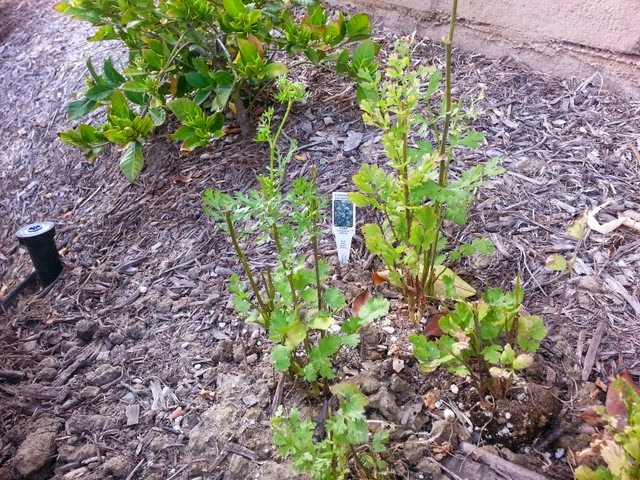
I am no farmer, nor green-thumb material. But when we finished our new landscaping late last year, the contractor left a few fruit trees--a couple of kumquats (金橘), one persimmon(紅柿), one Middle-Eastern berry tree, and a few low lying lemon shrubs--in our side and back yards, plus a couple of run-of-the-mill vegetables--green onions and bok-choy (白菜)--on a planter strip right behind the patio cement bench.


The vegetables were surprisingly easy grow, especially those bok-choy bunch: Within one month, they all had gone from tiny dirt grab to verdant green shoots, a couple feet tall, leaves palming wide. After taking one too many of our first ever organic farm produce and giving away a few to friends and neighbors, and their stalks shooting ever higher and started blossoming like giant wild flowers, I decided it's time for them to bow out of their commendable role in food service chain to mankind.

As it happened, I went to a local greenery shop and bought a parade of cute little fruit and vegetable pots for my "shock-and-awe" experiment: a cilantro herb, a garlic shoot, one pea vine, two squashes, two strawberries, 3 varieties of tomatoes, 4 varieties of sweet peppers, and one "finger potato," lining them all up on the same planter stretch where the bok-choys used to sit.

That unglamorous looking strawberry batch turned out to be the earliest pleasant surprise for me: Just a little more than a couple weeks after I planted them, on one of those random "see-if-some-of-them-have-died" checks, I was shock-and-awed by a few little red-and-whitish berries dangling at tips of this lowly crawl, some touching ground as the stems were still too soft and pliant to stick them up. To verify they were as real as they looked, I plucked some better looking ones and ate them. Some were as bland as those we occasionally get from the supermarket, but some were truly sweet and delightfully delicious! 

The squashes were the second surprises I got. Not only did they grow much more robustly than I thought they would (otherwise I would have placed them farther apart so they won't be elbowing each other like they do now), they actually started growing squashes--just like their namesake promises--in about one month period. These were tiny, finger size dills, no comparison to the commercial grade foot-long biggies we see in the market (thus spurned by my wife), but were really crisp, crunchy, sweet and juicy. I take them for breakfast and for snack, and they are as healthy and tasty as none others can be!

   
The little cilantro herb was actually edible right from the beginning, but I was really hung up by this question: How do I harvest it? It looks to me the whole thing from top to bottom is edible, really, but where should I cut it so the remnant part won't die and can still reproduce? So I kept on postponing, until it started shooting upward instead of crawling sideways, as its original humble frame seemed to indicate it should. So I started "harvesting" by cutting off its leaves and stems from about the mid-body, still not sure if I was doing it the right way. But doubt none about the condimental power of the part that I cut off. We threw a pinch of them in hot soup, and immediately the aroma came and the pungent taste it brought to our tongue was magical. The Great Discovery Era all started when people were looking for spices for trade, weren't they?

The pea vine actually formed its first pea pod way earlier than the first strawberry I saw--so early it was half-consumed by snails and worms already when I spotted it. If there's a first, there's bound to be a second, I thought, optimistically. But the second one never came, yet, and the vine itself seems to be going through some live-and-die cycle already... The mystery and nature of things this non-farming head could hardly understand.

All the tomatoes and sweet peppers are yet to produce their first fruits, though one of the sweet peppers looks promising, bell shaped baby pepper petaled by surrounding leaves, anxiously waiting to show up to the world who they are (and be eaten) soon...

The only plant that dies is the one that again to this urban farm head ought to be the most sturdy, easy-to-grow kind: the potato. I think it actually started withering the day right after I planted it. Be it disease, bugs, bad soil...? The fact the shrub next to it also dies, and it being the replacement from my landscaper for the previous one which also died, indicates ... you guess for me, I am clueless.


  ~ EIEIO ~

Monday, March 18, 2013

wiggle room

They say humans became intelligent beings when they started possessing the capability of language. But I think human brain is still a pretty primitive thing, even after thousands--or hundreds of thousands, depending on who you talk to--of years of evolution, the best way we can understand things is still through words directly related to how we see, touch, feel, and concrete objects like plants, animals, natural or man-made things that we can see, touch, feel, etc. Much of our language is then layered upon these tangible entities to convey more abstract ideas and concepts, or to infer different meanings out of these "figurative speeches," or so called "metaphors."

A metaphor can be a single word, such as "chairman"--the person who gets to sit in the meeting room is usually the head of an organization (here "head" is another example of metaphor), or a phrase ("piece of cake," "emotional rollercoasters"), but is usually one or two simple and easy to understand sentences (otherwise it beats the purpose of using metaphor) such as "Life is like a box of chocolates. You never know what you're gonna get." (from Forrest Gump, the movie). 

It can refer to plant ("couch potato"), or animal ("road hog"), be romantic ("You can't break my heart, it melted when I first saw you"), or downright insulting ("John is a real pig when he eats"). It can be imaginary ("pie in the sky"), or fact based ("It rains cats and dogs"-- Some say back in the medieval England when roofs were made of thatches and dogs and cats and other animals all lived on it, so when it rained they all slipped and fell). A lot of them are humorous ("A camel is a horse designed by a committee"), or inspirational ("Failure is the condiment that gives success its flavor"). And this one is political and timely: "When we read the budget proposal from the Senate, you find the Vatican is not the only place blowing smoke this week."--by Republican Congressman Paul Ryan during Vatican's selection of a new pope last week.

And it's definitely culture related. If you look closely, many phrases and expressions we use here: "hit the road," "strike a deal," "blow me away," "the idea was shot down," "Congress doesn't buy what the President proposes," "that's a sexy concept," ... expose an action (borderlining on violence) and sex and commerce packed society America is in today. Looking East, you find the many "eat" related terms in the Chinese language that ought not have anything to do with having food: 吃驚--taken by surprise, 吃苦--laboring, 吃虧--being taken advantage of, 吃罰單--getting a ticket..., indicating eating has been an important part of Chinese culture. One may argue there are quite a few eating related sayings in English language as well: "eat crow," "have cake and eat it too," "you are what you eat,"... So this could mean (of course) eating is an important part of all cultures universally.

Poems and literature by design use plenty of metaphoric expressions in their compositions. Robert Frost's poem "The Road Not Taken" (from which Dr. Scott Peck's famous book "The Road Less Traveled" gets its title) uses the forking of a trail to reflect the choice we make in life that leads to different and irretrievable paths. The Chinese poem verse "感時花濺淚 恨別鳥驚心" mixes flowers with "splashing tears," birds with "spooked heart," without much logical sense, but very effectively stirs up the deep emotions in us it intends to.

Even science and mathematics, the crown jewels of human intellectual exercise, use plenty of metaphors to present its theories and explain how things work in the world. "Imagine" the atom model that we were taught in school to help understand the very basic unit that forms the universe. It consists of a nucleus in the middle and electrons circling around it, like satellites orbiting a planet...  Did anyone actually "see" this with their eyes? Nope, not that it is so infinitesimally small that no man-made scope can capture it, but even if such scope exists, the moment we think we get it, it's no longer there, according to quantum mechanics theory... Also imagine without the help of the graphs and diagrams of lines, squares, triangles, waveforms, etc., how could we even get in the door, let alone understand the intricacies of Geometry and Trigonometry, sine and cosine, Fourier analysis, wave equation, etc., that form the basis of modern aeronautics, electronics, and other technologies and their applications?

I remember one thing the college professor who taught us Thermodynamics kept saying during his class: "If you speak abstractly, that means you don't understand." (Unfortunately this is about the only thing I remember from his class). I believe a great communicator is one who, after getting a firm grip (another metaphorical expression) of an idea, can re-package and re-deliver it with plain language--using examples, analogies, and metaphors, instead of jargons, theorems, and dry reasonings--so others can "get it" too.

Plato, the great Greek philosopher, actually used a visual metaphor to explain the central feature of his Theory of Ideas this way: Most human beings live as if in a dim cave. We are chained, and facing a blank wall, with a fire at our backs. All we see are flickering shadows playing across the cave wall, and this we take to be reality. Only if we learn to turn away from the wall and the shadows, and escape from the cave, can we hope to see the true light of reality.

A metaphoric speech urging you to get out of a metaphoric world, don't you find that interesting?

Religion is yet another field of human endeavor that's fraught with metaphors and symbolism. Take Christianity for an example: the Garden of Eden, the Trees of Life and Knowledge of Good and Evil, the Fall of Man, many of Jesus' sayings ("I am the vine and you are the branches," "you are the salt of the world"...) and parables (the wise and the foolish wedding maids, the mustard seed and the yeast...), the whole Old Testament as the "shadow" of the "fulfillment" of the New Testament, etc. Now here comes the rub: “Half the people in the world think that the metaphors of their religious traditions, for example, are facts. And the other half contends that they are not facts at all. As a result we have people who consider themselves believers because they accept metaphors as facts, and we have others who classify themselves as atheists because they think religious metaphors are lies.” -- Joseph Campbell, a comparative religion scholar. What I think both the atheists and the religious fundamentalists miss is the power of metaphor. One laughs at it (how can a virgin bear a child?), and the other takes it so seriously (the world must be created in 6 literal days). Relax, people, let's give each other some mental wiggle room to imagine, muse, and approach the truth through things we can relate to--through metaphors, that is. 

Finally, here is a "creative metaphor" for your enjoyment:
l(a

le
af
fa

ll
s)
one
l

iness
Have you figured it out? This is actually a short poem by E.E. Cummings, and is a "double metaphor." He associates loneliness with the falling of a leaf, and also visualizes the experience by isolating letters as they fall down the page. In plain one line writing, it would be: l(a leaf falls)oneliness.

*********************************************************************************************
Some famous metaphor quotes:

"A good conscience is a continual Christmas." -- Benjamin Franklin

"A hospital bed is a parked taxi with the meter running." -- Groucho Marx

"Art washes away from the sould the dust of everyday life." -- Pablo Picasso

"All our words are but crumbs that fall down from the feast of the mind." -- Khalil Gibran

"All religions, arts and sciences are branches of the same tree." -- Albert Einstein

"I'm a little pencil in the hand of a writing God, who is sending a love letter to the world." -- Mother Teresa

“Quantum theory provides us with a striking illustration of the fact that we can fully understand a connection, though we can only speak of it in images and parables.” -- Werner Heisenberg, Nobel Laureate physicist, co-founder of the field of Quantum Mechanics